
See also


 05.05.2026 01:54 PM
See also: InstaTrade trading indicators for WTI (CL)
The oil market is living through a dramatic week. West Texas Intermediate (WTI) prices corrected lower on Tuesday, consolidating around $101–$102 per barrel after Monday's powerful rally, which was triggered by an escalation in military confrontation in the Strait of Hormuz. The reason for the correction is a temporary easing of fears about immediate supply disruptions, but the underlying geopolitical tension remains extremely high, keeping prices well above the psychological $100 level.
Fundamental backdrop: Operation Freedom and Iran's response
On Monday, US President Donald Trump launched a naval operation called "Operation Freedom," aimed at escorting stalled commercial vessels through the Strait of Hormuz. Iran reacted immediately. According to media reports, Danish shipping company Maersk confirmed that its US-flagged vessel Alliance Fairfax successfully transited the strait under military protection.
However, other ships reported explosions and fires. Iran carried out missile and drone strikes on an oil port in the United Arab Emirates, where a major US base is located, causing a fire at a refining facility. The Pentagon said that US forces sank six Iranian fast attack craft involved in the attack. The UAE intercepted 12 ballistic missiles, three cruise missiles, and four drones.
Iranian parliament speaker Mohammad Bagher Ghalibaf said on Tuesday that a new equation had developed in the Strait of Hormuz, accusing the US and its allies of undermining energy transit by violating the ceasefire and imposing a blockade. Iranian foreign minister Abbas Araghchi stressed that there is no military solution to the crisis, calling for diplomatic engagement, including mediated efforts by Pakistan.
Thus, the oil market is caught between two opposing forces:
- Easing of immediate fears (a factor for correction). The successful passage of even one vessel under US military escort demonstrates that transit is technically possible. This temporarily reduces the fear of a full and immediate blockade, prompting profit-taking after the sharp rise.
- Continued high geopolitical risk (the foundation of the premium). Nevertheless, the situation remains fragile. Exchanges of strikes, attacks on allied infrastructure, and harsh rhetoric indicate that the conflict is far from resolved. Any new escalation could trigger the next price shock. This duality explains the market's high volatility.
Oil market analysts emphasize that the escalation between the US and Iran in the Strait of Hormuz supports volatility and that growing geopolitical risks test the fragile ceasefire and increasingly threaten global inflation, despite earlier optimistic forecasts.
Fed and outlooks
- Dallas Fed official Lori Logan, a hawk on policy, recently said that a deal between the US and Iran remains unlikely, which further highlights supply risks.
- Danske Bank stresses that rising tensions are testing the fragile ceasefire and that inflation risks are becoming more obvious.
- BNY keeps a forecast for two Fed rate cuts in Q4, conditional on the Strait of Hormuz reopening and falling oil prices.
As long as the strait remains a theater of military confrontation, hawkish pressure on the Fed will persist, supporting the dollar, but not directly exerting a bearish influence on WTI prices quoted in dollars.
Brief technical analysis
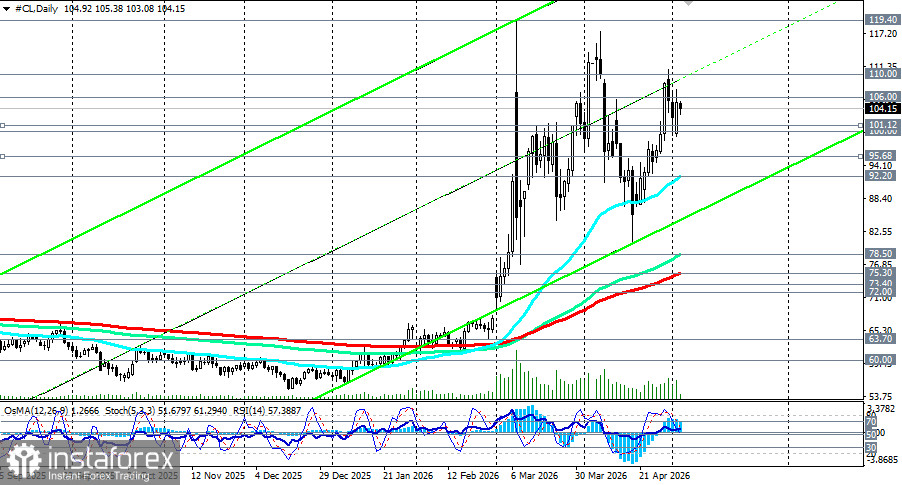
From a technical viewpoint, WTI is in a short-term correction phase after the powerful jump but retains a bullish structure.
On the daily chart, all key EMAs (50, 144, 200) are aligned in bullish order and point upward, which signals long-term control by the bulls.
- On the daily chart, the RSI (14) sits at 57, indicating a non-overbought bullish impulse and leaving room for further gains.
- On the daily chart, the OsMA remains in positive territory, at 1.2680, well above the zero line.
- The stochastic has exited overbought territory and is moving down, signaling a correction, but it remains on the buy side (above the midline).
Key events
- Today, 5 May: ISM Services and JOLTS in the US — impact on the dollar and Fed expectations.
- 8 May: US nonfarm payrolls report — influence on the dollar and risk sentiment.
- Daily: any reports of military action in the Strait of Hormuz — the main geopolitical trigger, capable of causing instantaneous price shocks.
Conclusion
The oil market is frozen in a tense equilibrium, balancing between two realities. On the one hand, the successful transit of the first vessel under US escort temporarily eased fears of a total blockade, triggering profit-taking. On the other hand, military confrontation in the Strait of Hormuz continues, and any renewed escalation could instantly drive prices back to, and above, previous highs.
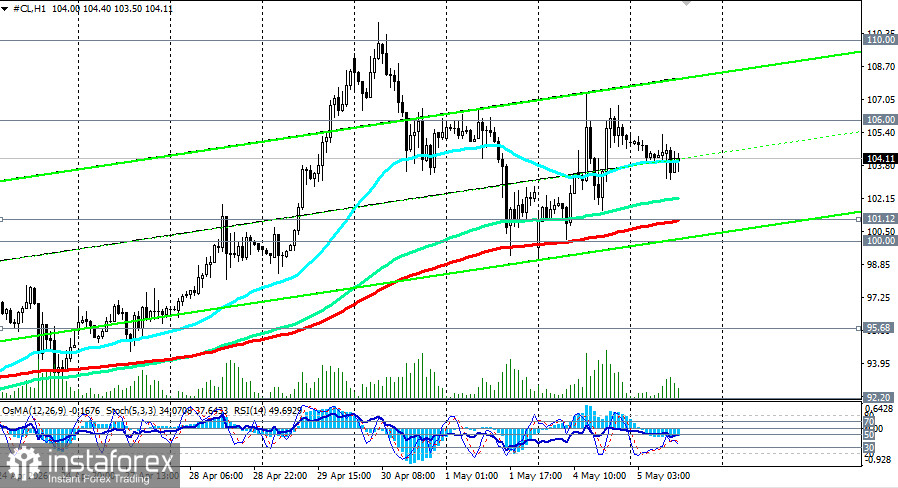
The key zone 100.00–101.12–106.00 will be the arena of decisive battles in the coming days. Holding above 101.12 and the psychological level 100 will indicate the preservation of the bullish structure, while a break above 106.00 would open the road to $110.00 and $114.30.
See also: WTI (CL): scenarios of movement on 05.05.2026
Rising tensions are testing the fragile ceasefire, and inflation risks are becoming more apparent. As long as the strait remains the new equation, oil prices will stay highly volatile and sensitive to headlines. Investors should closely monitor military and diplomatic developments around the Strait of Hormuz.


