
See also


 23.04.2026 10:38 AM
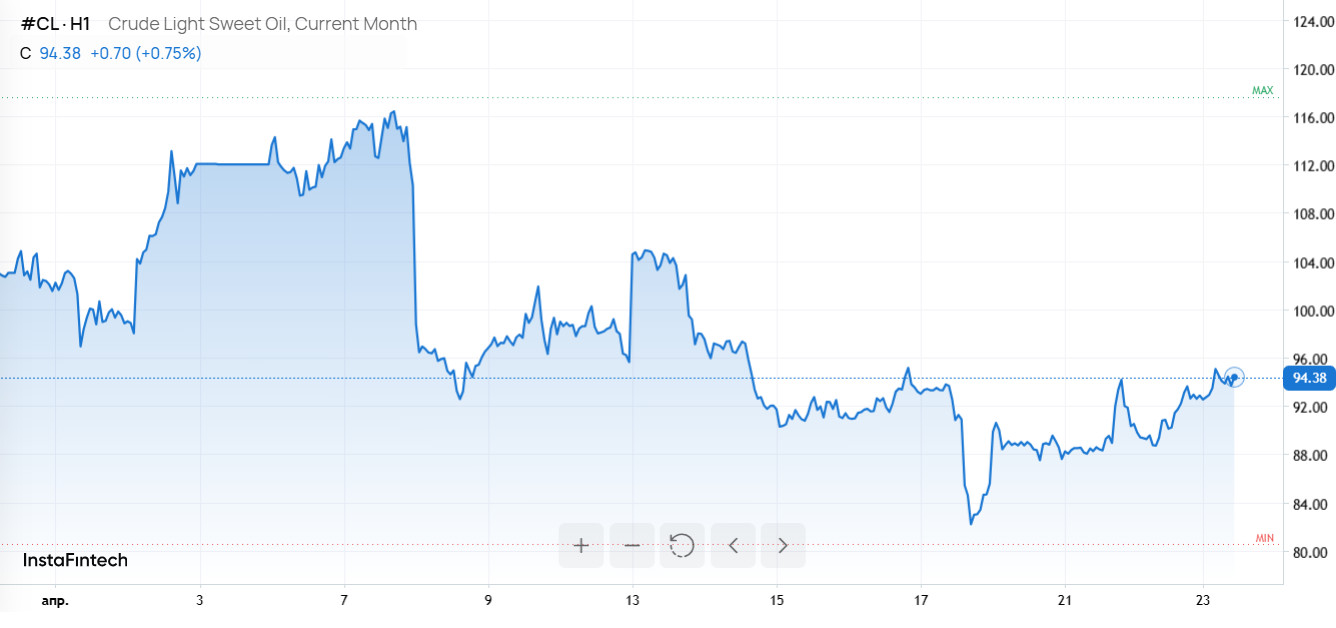
Oil prices continued to climb for a third trading session on Thursday. The rise is being supported by two factors at once: stalled peace talks between the US and Iran and mounting disruptions to shipping through the Strait of Hormuz.
According to Reuters, Brent futures were up 1.3% in early Asian trading, to $103.28 a barrel. Earlier on Wednesday, the contract closed above $100 for the first time in more than two weeks. At the same time, WTI futures rose 1.6% to $94.48 a barrel.
Both key benchmarks finished the previous session more than $3 higher as the market reacted to two stronger-than-expected drivers: a notable drop in US gasoline and distillate inventories and a lack of progress in diplomatic efforts.
Against this backdrop, hopes for a swift diplomatic settlement are fading. President Donald Trump extended the ceasefire with Iran at Pakistan's request, yet the US naval blockade of Iranian ports, in effect since April 13, remains in place.
As reported, Vice President J.D. Vance, who was to head the US negotiating team for the second round of talks in Islamabad, canceled the trip, while Iran never confirmed its willingness to take part in the second round.
Analysts note that "the oil market is revising expectations amid virtually no signs of a settlement in the Persian Gulf," and "hopes for resolving the crisis are waning as peace talks reach an impasse."
Trump has blamed the delay on Iran's "deeply divided" leadership and said he will wait until Tehran's leaders "produce a unified proposal."
The situation is being fueled by further escalation. According to NPR and Iranian state media, in recent days, the Islamic Revolutionary Guard Corps attacked at least three commercial vessels near the strait and seized two of them.
Iran, for its part, accuses the vessels of operating without proper permits — just days after it accused the Americans of "piracy" for seizing the Iranian cargo ship Touska on April 19.
The Strait of Hormuz, through which about 20% of the world's daily oil shipments passed before the war began on February 28, is effectively closed to normal commercial navigation.
The International Energy Agency described the current regime as "the largest disruption to supply in the history of the global oil market."
Compensating supplies from the US: there is growth, but it is not a "complete solution" While Asian and European countries are urgently seeking alternatives, US crude oil and petroleum product exports have risen to a record 12.88 million barrels per day. That is 137,000 barrels per day more than the previous week (Reuters).
Crude oil exports alone are about 5.44 million bpd in April and 5.48 million bpd in May. According to Kpler, that is roughly three times prewar shipment volumes to Asia.
Nevertheless, analysts warn that even a significant increase in US exports cannot fully offset the loss of flows from the Persian Gulf. Moreover, even under the most favorable scenario of the strait suddenly reopening, the market may not receive immediate relief: the EIA forecasts that traffic will not return to prewar levels before the end of 2026.
Key takeaways for traders
In short, while US crude and product exports have hit a record 12.88 million barrels per day, analysts believe this will not fully compensate for the loss of Persian Gulf flows. The EIA's forecast points to no return to prewar traffic levels before late 2026.


