
Vea también


 19.10.2026 10:30 AM
The Elliott wave count on the 4-hour chart for EUR/USD has become more complex. On the higher time frame (lower chart), the downward trend segment has taken the form of a five-wave A-B-C-D-E structure, which could be completed at any time, as it appears to be fully developed. All waves within this segment are approximately equal in size, which is why it is considered corrective. If this assumption is correct, a new impulsive upward trend segment will begin once the structure is complete, with targets well above the 1.2000 level.
On the lower time frame (upper chart), an impulsive wave sequence is still developing and may belong to wave E of the higher time frame. If this is indeed the case, the dollar's strengthening is nearing its end, regardless of how much further it rises. The expected wave 5 of E is either complete or close to completion. In any case, the current wave structure suggests that the downward wave sequence is nearing completion on both charts. The news background and a sharp shift in market sentiment triggered a strong rally in the US dollar, but the number of new reasons for further dollar strength is gradually diminishing.
The euro is beginning to recover.
EUR/USD rose by 20 basis points on Friday, which is a very modest increase. However, under current conditions, it is crucial for the euro to maintain its upward momentum. As a reminder, the US inflation report released on Wednesday initially triggered renewed buying of the US dollar, but sellers then retreated sharply. On Thursday, buyers began to apply pressure, even though the US Producer Price Index (PPI) showed an even stronger increase than both headline and core inflation. Consequently, market participants had grounds for another wave of US dollar buying but chose not to pursue it. Could this be because the wave count points to the completion of two downward trend segments at once: a local one and a global one?
There will be plenty of significant events worldwide this week, but not all of them warrant particular attention. Over the past month, the market has focused almost exclusively on buying the dollar, while the last few days may have brought the first signs of a long-term trend reversal. Therefore, the news background may influence market sentiment and trading activity, but the market has not always responded to news in recent weeks. It may continue to ignore some releases this week as well.
Accordingly, attention will focus on the most important events. On Wednesday, the UK will release its inflation report, which should convince traders that tighter monetary policy from the Bank of England is not a remote or hypothetical possibility, but a tangible prospect that could materialize in the near future. UK inflation has a strong chance of accelerating to 3.4% in September and reaching 4% by the end of the year, according to Andrew Bailey. Consequently, the BoE has little choice but to raise interest rates. Andrew Bailey is also scheduled to speak this week and may provide the market with several signals pointing to a possible tightening as early as the beginning of November. In my view, the euro and the pound could strengthen over the next five days.
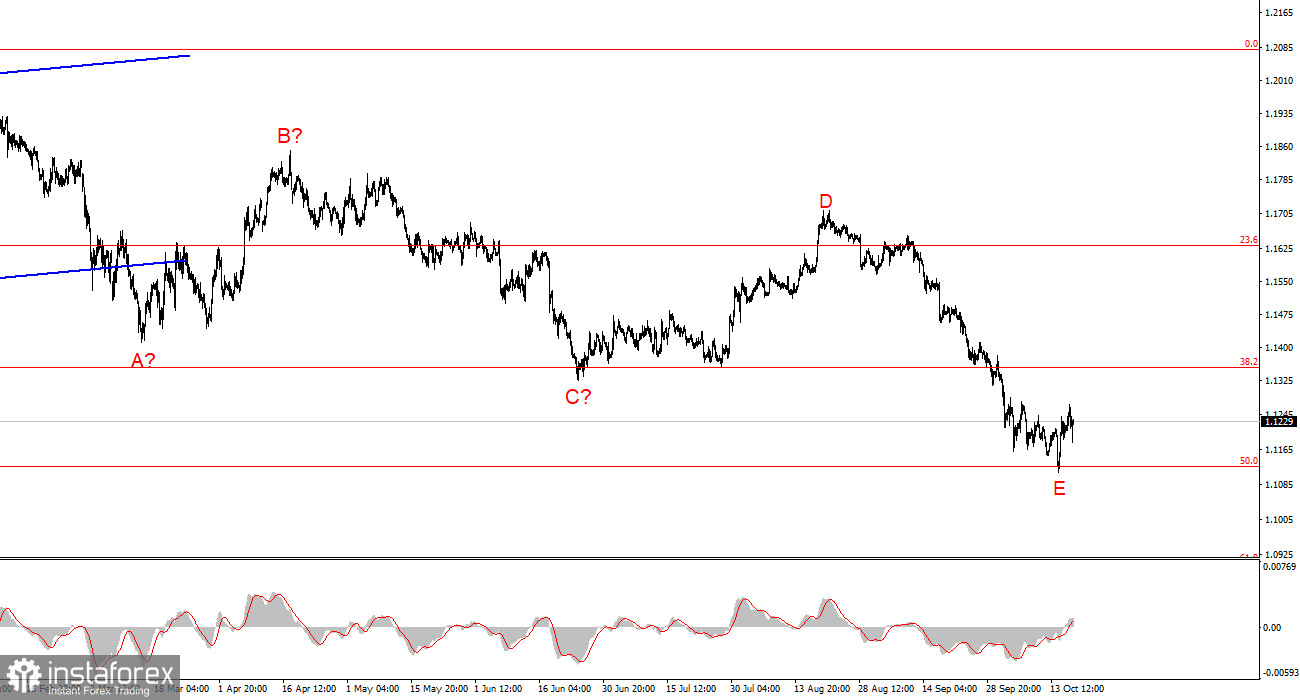
Based on the EUR/USD analysis, the pair remains within the global corrective A-B-C-D-E trend structure. However, this structure appears fully developed and may therefore be complete. In my view, this is a favorable time not only to consider buying the euro but also to anticipate the development of a sustained upward trend segment. According to the higher time frame, the pair could rise to at least the 1.1700–1.1800 level. The unsuccessful attempt to break above the 1.1126 level, which corresponds to the 50.0% Fibonacci retracement level (lower chart, higher time frame), also indicates that the market may be preparing for renewed buying.
The higher time frame shows a downward trend segment that has taken the form of an A-B-C-D-E structure. The internal wave structure of wave E has developed into a five-wave impulse pattern, but this pattern may already be complete. If this assumption is correct, a new upward trend segment will begin to develop.
The Main Principles of My Analysis:
1. Wave structures should be simple and easy to understand. Complex structures are difficult to trade and often undergo changes.
2. If there is no clear understanding of what is happening in the market, it is better to stay out.
3. There can never be absolute certainty about the direction of price movement. Do not forget to use protective Stop Loss orders.
4. Wave analysis can be combined with other forms of analysis and trading strategies.


