
Vea también


 21.10.2026 01:16 PM
The euro failed to make the anticipated gains during the first half of the day. In the morning, the pair was unable to move above 1.1232, then declined to nearly 1.1215 before recovering to 1.1227 by the beginning of the second half of the day. The reason is straightforward: the Bundesbank's conclusions fell short of what euro buyers had expected.
According to the central bank's assessment, the German economy likely stagnated in the third quarter. GDP grew by 0.3% in both the first and second quarters, and the Bundesbank had expected modest growth in September. Therefore, its latest assessment came as a disappointment. The report states that temporary factors are primarily responsible, particularly low water levels on the Rhine, and that economic output is expected to accelerate noticeably again in October and December. For beginners, one important point is worth understanding: when the region's largest economy stagnates, investors find it difficult to remain confident in the euro, even when the causes are described as temporary. Moreover, the economy had previously performed better than expected, and the government recently raised its annual growth forecast to 1.3%, more than double the previous estimate. However, high energy prices continue to weigh on economic activity, while Germany's investor sentiment index deteriorated on Tuesday for the first time since April.
Inflation is another concern. It reached 3.3% in September, compared with the ECB's 2% target, and the Bundesbank believes it is likely to remain elevated for some time. The central bank highlighted a very high degree of uncertainty, particularly regarding energy prices. It warned that the longer the oil shock persists and the more other energy sources become expensive, the greater the risk of indirect effects driving inflation above expectations. This combination of stagnant growth and high prices puts the ECB in a difficult position, depriving the euro of support. As long as energy prices remain high and growth risks persist, EUR/USD is likely to have limited scope for a sustained rebound.
There will be no US economic data releases or speeches by Federal Reserve officials in the second half of the day, as the Fed traditionally enters a quiet period ahead of its policy meeting. Therefore, the pair remains at the mercy of geopolitical developments. The Middle East will be the main driver for the US dollar, as any movement in energy prices is immediately reflected in bond yields, which in turn influence sentiment toward the US currency. If oil and gas prices begin to rise, bond yields will increase, supporting the dollar. If energy prices decline, the euro may have an opportunity to rebound. Without new signals from this front, a sustained move in either direction seems unlikely. Minor fluctuations around key levels should therefore not be mistaken for trading signals.
Momentum
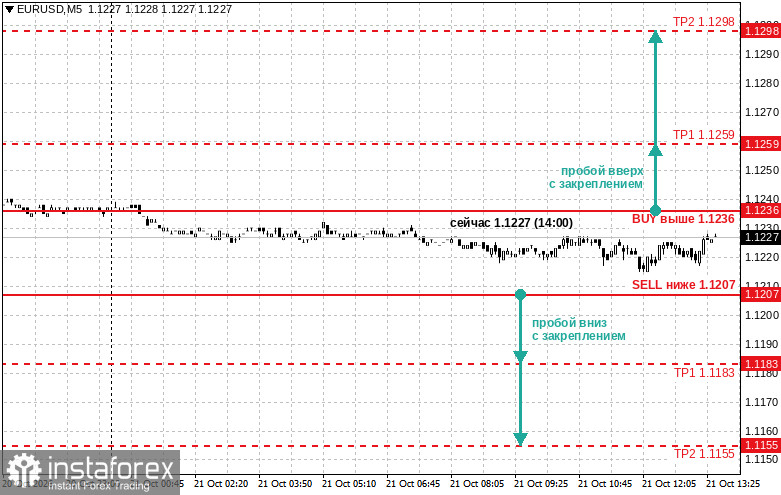
For the euro, the main resistance level is 1.1236, while the key support level is 1.1207. At 1.1227, the price is nine pips below the upper level and 20 pips above the lower one.
For long positions, the price needs to consolidate firmly above 1.1236 and remain there. The targets would then be 1.1259 and 1.1298. This scenario appears unlikely. The morning high failed to reach the level, and the Bundesbank's statements did not provide a catalyst for further gains.
For short positions below 1.1207, the targets are 1.1183 and 1.1155. Today's low of around 1.1215 has not reached this level, but the overall market backdrop favors sellers. This scenario appears more likely than a move higher. Nevertheless, entering a position before a confirmed breakout would be premature.
Mean Reversion
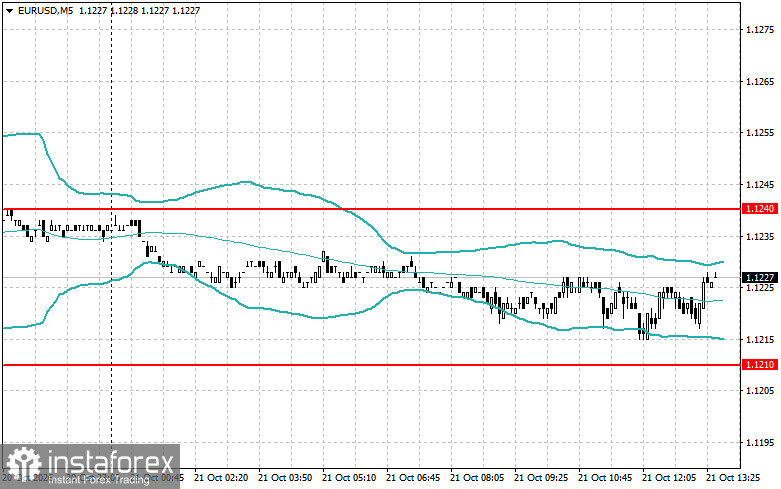
For the euro, the mean-reversion levels are 1.1240 and 1.1210. Both are very close to the corresponding breakout levels. The upper level of 1.1240 is four points above the breakout-buy level of 1.1236, while the lower level of 1.1210 is three points above the breakout-sell level of 1.1207.
A difference of three or four pips is merely market noise. It is impossible to distinguish a breakout from a reversal on the first test alone, so beginners should exercise particular caution.
If the price rises above 1.1236, reaches 1.1240, and then quickly falls back below it, short positions may be considered. This would resemble the morning's price action, when the anticipated rise failed to materialize. However, if the price consolidates above 1.1240, this would confirm a breakout, and selling should be avoided.
The lower-level scenario works in the opposite direction. If the price drops below 1.1210, reaches 1.1207, fails to remain below it, and then moves back above the level, long positions may be considered, with a stop-loss below the low of the brief downward move. If the price instead consolidates below 1.1207, the mean-reversion scenario has failed, and attention shifts to the target at 1.1183.


