
Vea también


 17.03.2026 07:36 PM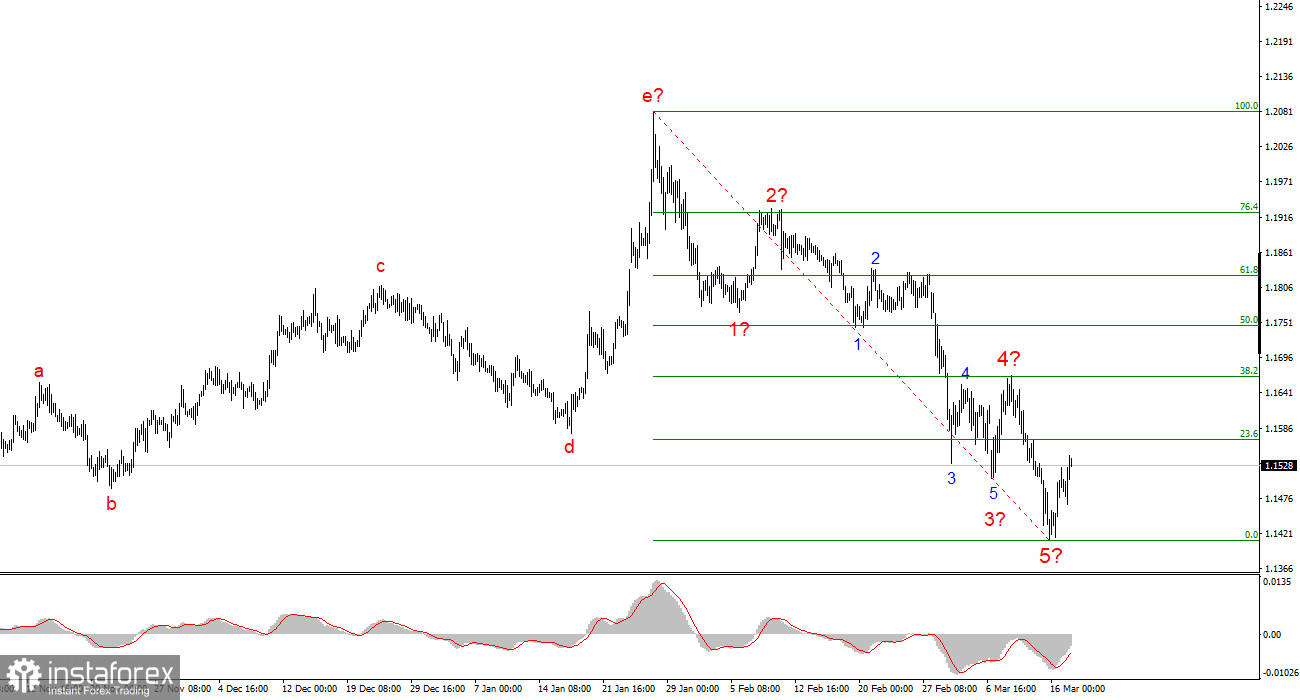
The wave pattern on the 4-hour chart for EUR/USD has changed. There is still no indication that the upward trend segment, which began in January last year, has been canceled, but the wave structure now looks quite ambiguous. In such situations, I always recommend switching to a lower timeframe and focusing on the simplest and smallest wave structures to make short-term forecasts, which is sufficient for opening trades.
In the chart above, a classic five-wave impulse structure can be identified, with an extended third wave. If this is correct, then this structure has been completed, and a corrective phase of at least three waves is expected. Therefore, in the near term, a rise in the pair can be expected, but within a correction relative to the most recent trend segment. Recent wave structures do not fit well into the higher-level count, but this should become clearer over time. In the near future, the euro may recover toward the levels of 1.1568 and 1.1666.
The EUR/USD pair showed little change on Tuesday, failing to sustain Monday's trend. Price movement was limited, and the market found little interest in the ZEW institute reports. Although the euro was under pressure during the morning session, the market quickly shifted focus from economic data to more pressing topics.
Geopolitics may continue to influence trader sentiment for an extended period. Meanwhile, the FOMC meeting will take place tomorrow evening and could become a key event in the first half of 2026. The following day, the European Central Bank will hold its meeting, which may also impact the market in either direction. At present, central banks are concerned that inflation could accelerate again globally. These concerns are not unfounded, as oil and gas are used in the production, transportation, and storage of nearly all goods. Even the cost of services is indirectly linked to energy prices. Therefore, prices may rise regardless.
It is worth recalling that last year many economists also expected a sharp increase in prices when Donald Trump initiated a trade conflict, but this did not materialize. For this reason, it is too early to draw pessimistic conclusions. It should also be noted that the Federal Reserve has a dual mandate, and at least one of its objectives still calls for further monetary easing, regardless of inflation.
Thus, tomorrow evening we will learn the position of the FOMC in the context of rapidly evolving global events. In my view, the Federal Reserve will maintain a wait-and-see approach, as it remains unclear how long the Middle East conflict will last. In some respects, the situation has reached a stalemate: Donald Trump has not secured sufficient support from European countries, while Iran has not yielded under pressure from Israel, the United States, and their allies, nor has it abandoned its nuclear program or entered negotiations.
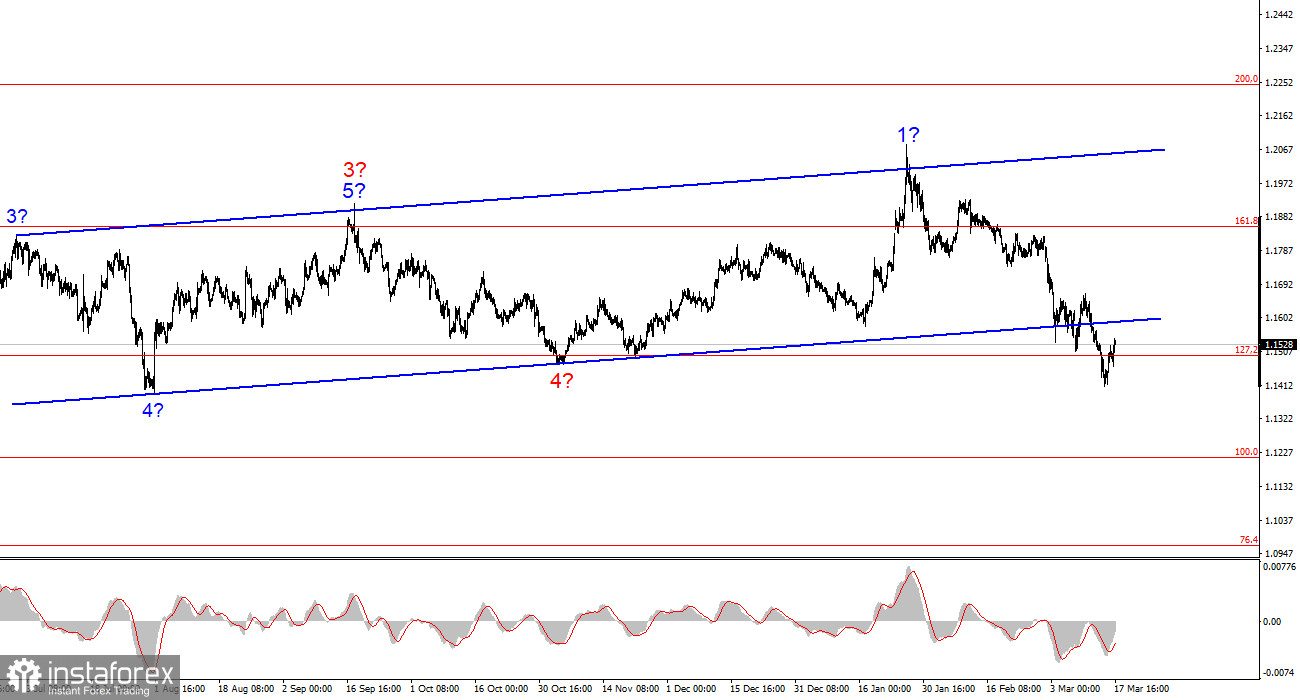
Based on the analysis, EUR/USD remains within an upward trend segment (as shown in the lower chart), but in the short term has begun forming a downward phase. Since the five-wave impulse structure appears complete, a rise in the pair can be expected over the next one to two weeks, with targets near 1.1568 and 1.1666, corresponding to the 23.6% and 38.2% Fibonacci levels. Further movement will depend entirely on developments in the Middle East.
On a smaller timeframe, the entire upward trend segment is visible. The wave structure is not entirely standard, as corrective waves vary in size. For example, the higher-level wave 2 is smaller than the internal wave 2 within wave 3. Such variations do occur. It is important to focus on clear and understandable structures rather than attempting to strictly label every wave. The trend may reverse in the near future.
Key principles of this analysis:


