
Vea también


 04.08.2026 01:12 PM
Trade Review and Tips for Trading the British Pound
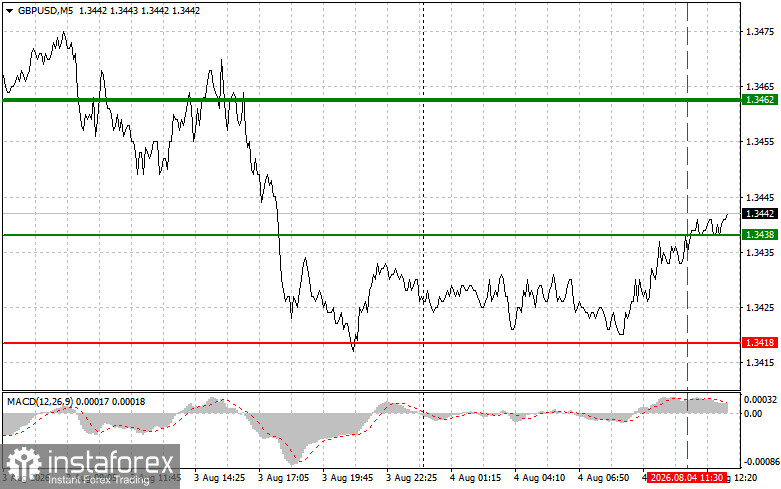
The test of the 1.3438 level occurred when the MACD indicator had already moved well above the zero line, limiting the pair's upward potential. For this reason, I did not buy the pound.
Buying opportunities also lacked appeal, as the empty UK economic calendar resulted in only modest gains for the pound during the first half of the day. Normally, the direction of the British currency is driven by more significant economic releases, but today there were no such catalysts.
The market's attention now turns to the U.S. trade balance, the Bureau of Labor Statistics' Job Openings and Labor Turnover Survey (JOLTS), and factory orders. The JOLTS report is considered a key indicator of labor market conditions, as the number of job openings is used to assess labor market tightness, which in turn influences expectations for the Federal Reserve's monetary policy. Under these circumstances, the pound's direction will largely depend on external factors. Strong U.S. data could strengthen the dollar and put downward pressure on GBP/USD, while weaker-than-expected figures would support the pound by weighing on the U.S. currency. With no major domestic catalysts today, the pound is likely to take its direction from overall market risk sentiment, while the U.S. dollar's reaction to the data will determine the outcome.
As for my intraday strategy, I will primarily rely on the implementation of Scenario #1 and Scenario #2.
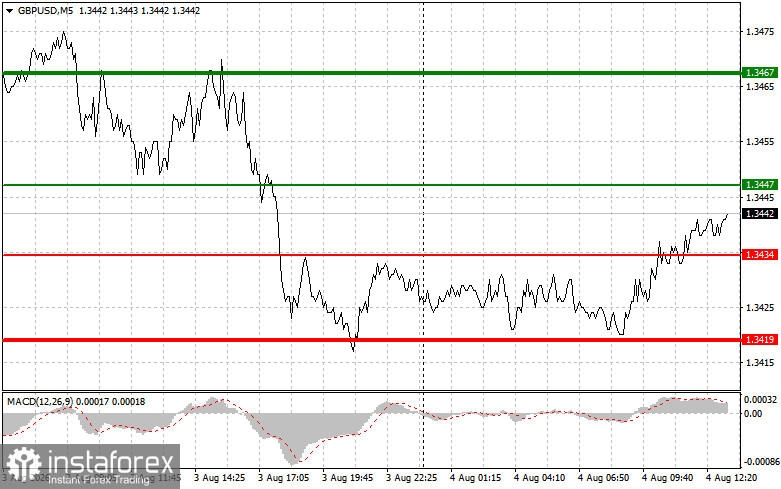
Scenario #1: Today, I plan to buy the pound if the price reaches the entry level around 1.3447 (green line on the chart), targeting a rise to 1.3467 (the thicker green line on the chart). At 1.3467, I plan to close long positions and open short positions, expecting a 30–35 point pullback. The pound is likely to rise today only if the U.S. data come in weaker than expected.
Important: Before opening a long position, make sure the MACD indicator is above the zero line and is just beginning to move higher.
Scenario #2: I also plan to buy the pound if the 1.3434 level is tested twice consecutively while the MACD indicator is in oversold territory. This would limit the pair's downward potential and trigger a bullish reversal. In this case, a rise toward 1.3447 and 1.3467 can be expected.
Scenario #1: I plan to sell the pound after the price breaks below 1.3434 (red line on the chart), which is expected to trigger a rapid decline in the pair. The primary downward target is 1.3419, where I plan to close short positions and immediately open long positions, expecting a 20–25 point rebound. Downward pressure on the pound is likely to return if the U.S. data come in stronger than expected.
Important: Before opening a short position, make sure the MACD indicator is below the zero line and is just beginning to move lower.
Scenario #2: I also plan to sell the pound if the 1.3447 level is tested twice consecutively while the MACD indicator is in overbought territory. This would limit the pair's upward potential and trigger a bearish reversal. In this case, a decline toward 1.3434 and 1.3419 can be expected.
Important: Beginner Forex traders should exercise great caution when making trading decisions. It is generally advisable to stay out of the market ahead of major fundamental releases to avoid sharp price swings. If you choose to trade during news releases, always use stop-loss orders to minimize potential losses. Trading without stop-loss orders can quickly result in the loss of your entire deposit, especially if you trade large position sizes without proper risk management.
Finally, remember that successful trading requires a clear trading plan, such as the one outlined above. Making spontaneous trading decisions based solely on current market conditions is generally a losing strategy for an intraday trader.


