
Vea también


 31.07.2026 03:26 PM
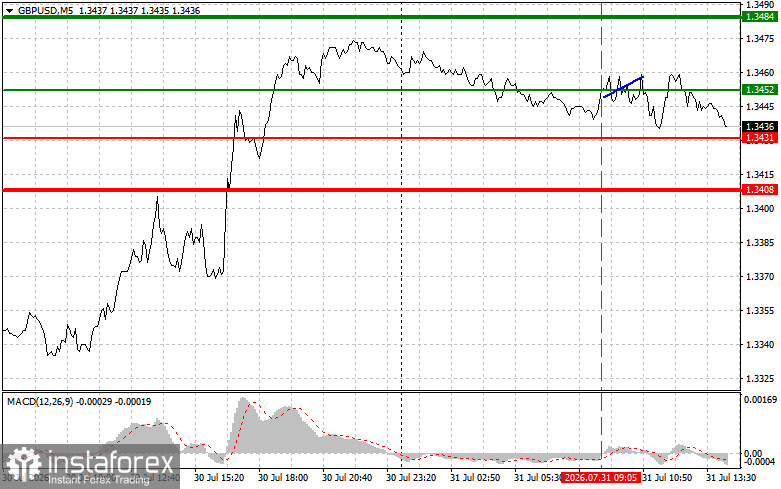
The test of the 1.3452 level occurred when the MACD indicator was just beginning to move higher from the zero line, confirming a valid entry point for buying the pound. However, the pair failed to generate a significant upward move.
The direction of the pound during the U.S. session will be determined by upcoming U.S. economic data, namely the University of Michigan Consumer Sentiment Index and inflation expectations, as the British currency currently lacks significant domestic catalysts. The Consumer Sentiment Index reflects consumers' confidence in the economy, while inflation expectations indicate how households view future price growth. Both indicators have the potential to significantly influence market sentiment. Strong readings could restore demand for the U.S. dollar and trigger its strengthening at month-end. Under such conditions, the pound will become increasingly dependent on external factors. In addition to the risk of a stronger U.S. dollar, profit-taking may also weigh on the currency, as GBP/USD appears vulnerable to a pullback following its strong rally in recent sessions. Traders often reduce long positions at the end of the month, and such a correction could put additional pressure on the British pound. As a result, its near-term direction will largely depend on the performance of the U.S. dollar.
As for the intraday strategy, I will primarily rely on the implementation of Scenario #1 and Scenario #2.
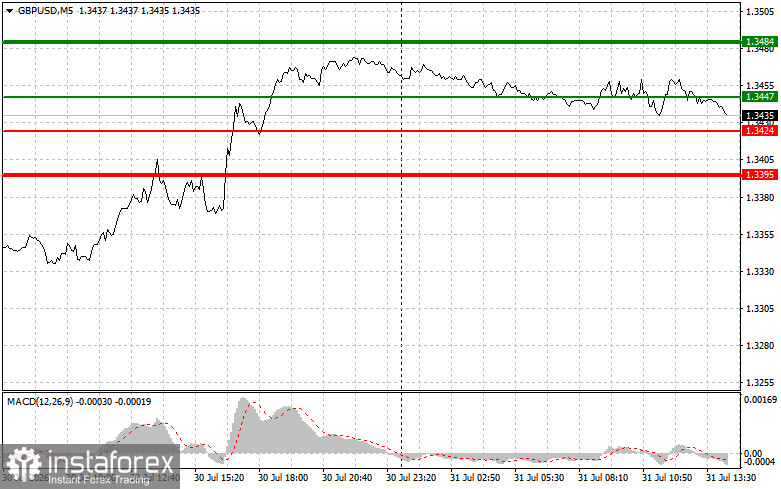
Scenario #1: Today, I plan to buy the pound if the price reaches the entry point around 1.3447 (the green line on the chart), targeting a rise to 1.3484 (the thicker green line on the chart). Around 1.3484, I plan to close my long positions and open short positions, expecting a 30–35 point move in the opposite direction from that level. A stronger pound today can only be expected if the U.S. data comes in weaker than expected.
Important: Before buying, make sure that the MACD indicator is above the zero line and is just beginning to move higher from it.
Scenario #2: I also plan to buy the pound if there are two consecutive tests of 1.3424 while the MACD indicator is in oversold territory. This will limit the pair's downward potential and trigger a bullish market reversal. In this case, a rise toward the opposite levels of 1.3447 and 1.3484 can be expected.
Scenario #1: I plan to sell the pound after the price breaks below 1.3424 (the red line on the chart), which should lead to a rapid decline in the pair. The key target for sellers will be 1.3395, where I plan to close my short positions and immediately open long positions, expecting a 20–25 point rebound from that level. Selling pressure on the pound is likely to return if the U.S. economic data comes in stronger than expected.
Important: Before selling, make sure that the MACD indicator is below the zero line and is just beginning to move lower from it.
Scenario #2: I also plan to sell the pound if there are two consecutive tests of 1.3447 while the MACD indicator is in overbought territory. This will limit the pair's upward potential and trigger a bearish market reversal. In this case, a decline toward the opposite levels of 1.3424 and 1.3395 can be expected.
Important: Beginner Forex traders should exercise great caution when making market entry decisions. It is generally best to stay out of the market before the release of major economic reports to avoid sharp price fluctuations. If you decide to trade during news releases, always use stop-loss orders to minimize potential losses. Without stop-loss orders, you can lose your entire trading account very quickly, especially if you do not apply proper money management and trade with excessively large position sizes.
Remember that successful trading requires a clear trading plan, such as the one outlined above. Making spontaneous trading decisions based solely on the current market situation is inherently a losing strategy for an intraday trader.


