
Vea también


 08.06.2026 01:05 AM
Bitcoin and Ethereum continue to fall. This week, Bitcoin has lost 17% of its value or $13,000, while Ethereum has dropped 21% or $433. One can argue endlessly about why the cryptocurrency market is crashing again, but we have been warning about this for the past three months, even without considering geopolitics, inflation, and shifts in the Federal Reserve's sentiment.
Meanwhile, experts have begun analyzing why Bitcoin lost 50% of its value and experienced a new crash last week. It turns out that the reasons are quite apparent. For example, the sharply rising cost of electricity amid the war in the Middle East has combined with the decline in Bitcoin's value over the last eight months. When Bitcoin is worth more than $100,000, it is pleasant for miners. When the price drops to $70,000, and electricity costs rise by 1.5 times, the pleasure diminishes. Thus, not only are investors shifting capital into more promising sectors like AI from a profit perspective, but miners themselves are also moving into the AI sector, as that area requires computational power.
At the same time, miner rewards decrease every four years due to the "halving." Some "experts" believe that the "halving" itself should lead to a doubling of the value of "digital gold," as otherwise it would simply become unprofitable to mine. We believe that this predictive logic is flawed. As the "halving" decreases miner rewards by half every four years, interest in the mining process will decline. According to forecasts, the last Bitcoin block will not be mined until at least 2100. This means that during this time,, Bitcoin should increase in value by at least 2x every 4 years. It is not difficult to calculate that by 2100, one coin should be worth... $15 billion.
It is logical to assume that this will not happen under any circumstances unless hyperinflation "devours" fiat money each year. This is why we do not believe in forecasts of perpetual Bitcoin growth. For Bitcoin to rise continuously (in the long term), demand for it must constantly increase. However, demand is not limitless. Liquidity is not limitless. Beyond Bitcoin, new technologies are constantly emerging that also offer profits to investors. A striking example is artificial intelligence. By 2100, a multitude of new technologies could be invented; therefore, it is unrealistic to think that Bitcoin will be bought and valued forever.
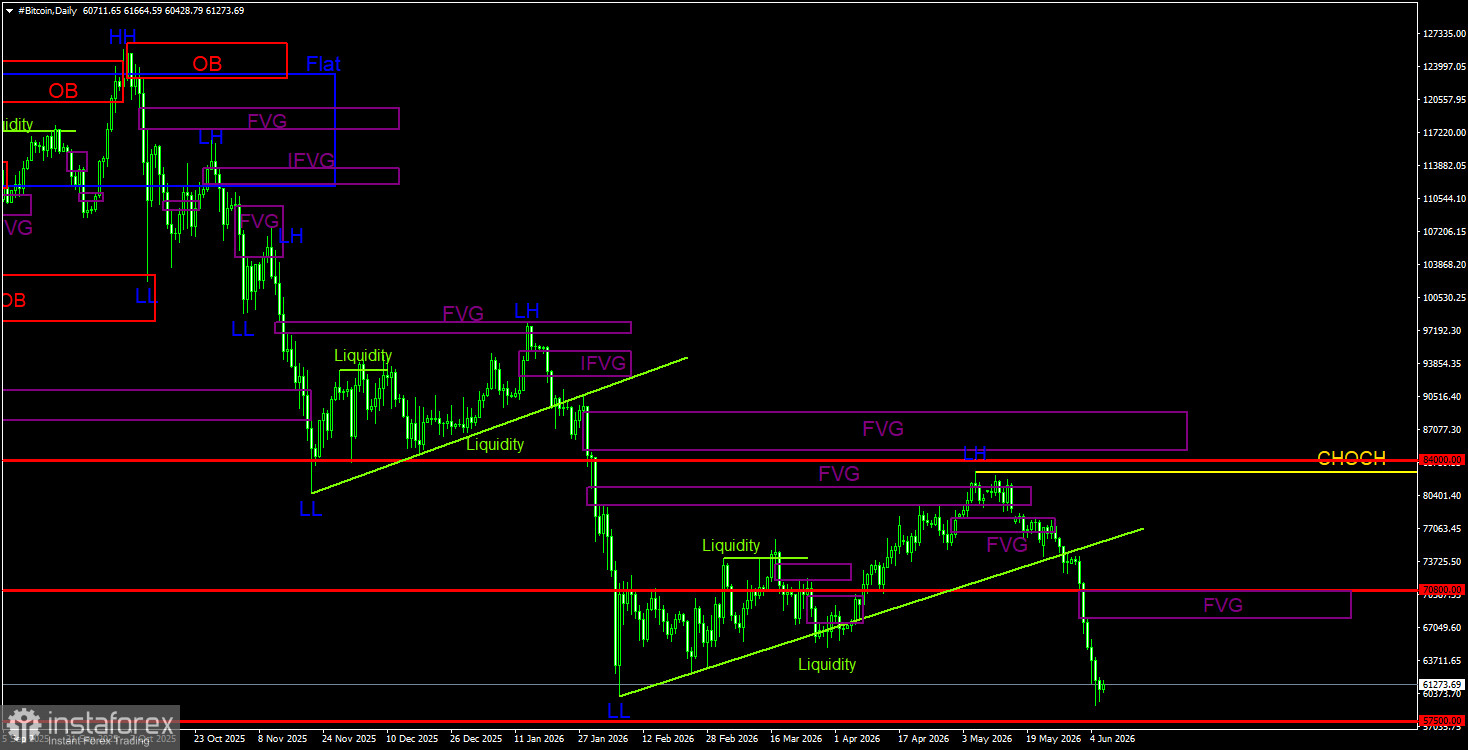
Bitcoin continues to form a full-fledged downward trend and a correction against it. We continue to expect a decline toward $57,500 (the 61.8% Fibonacci level of a three-year upward trend), and there are still no signs of a long-term upward trend beginning. A new bearish FVG pattern has formed in the $68,000 – $70,700 area, so this area serves as a point of interest (POI) for traders in the coming weeks. Patterns may also form on the 4-hour timeframe, but first, the crash must complete, and a correction must begin.
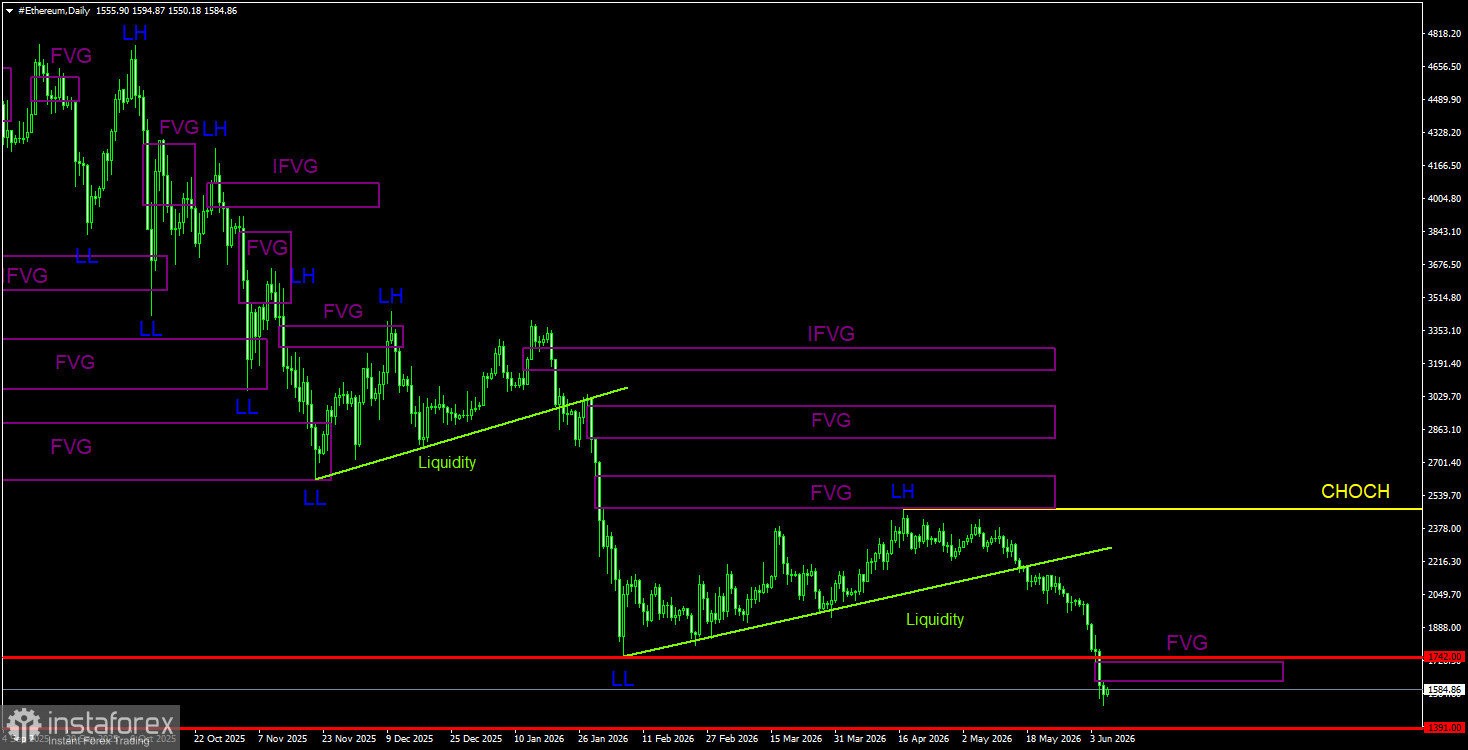
The daily timeframe continues to show the downward trend that began last August. The key selling pattern has been and remains the bearish Order Block on the weekly timeframe. As we have warned, the movement triggered by this signal may be strong and prolonged. We do not believe it is over, as there are no signs of a completed downward trend for either Bitcoin or Ethereum. In the near term, Ethereum may continue to decline with targets of $1,391 and $788. An upward correction can be expected when at least some bullish patterns or other signs of an upward price reversal form on the 4-hour timeframe. New areas of POI for selling should be sought on the daily timeframe.


