
Vea también


 09.03.2026 07:11 PM
The EUR/USD pair declined a little more on the first day of the week and is moving further away from the only working pattern — imbalance 11 — while also getting closer to breaking the bullish trend. The blue line on the chart marks the level below which the bullish trend will most likely be considered finished. A long-term sideways movement cannot be completely ruled out, since all movements since July of last year can easily be interpreted, if desired, as a sideways range with a slight upward bias. It is also possible that liquidity will be taken from the lows of November 4 and July 31 of last year, after which the growth of the European currency will resume. Thus, there are currently plenty of possible scenarios. What is missing is an understanding of which of them will be implemented and clear signals for traders. Traders continue to trade exclusively on events related to the war in Iran and energy prices. Today oil showed growth to nearly $120, and some experts believe that if the war in the Middle East continues, black gold may jump to $215 per barrel. Thus, in the near future we may see bear attacks more than once. But we may also see none at all if the situation in the Middle East begins to gradually improve — or at least stops worsening.
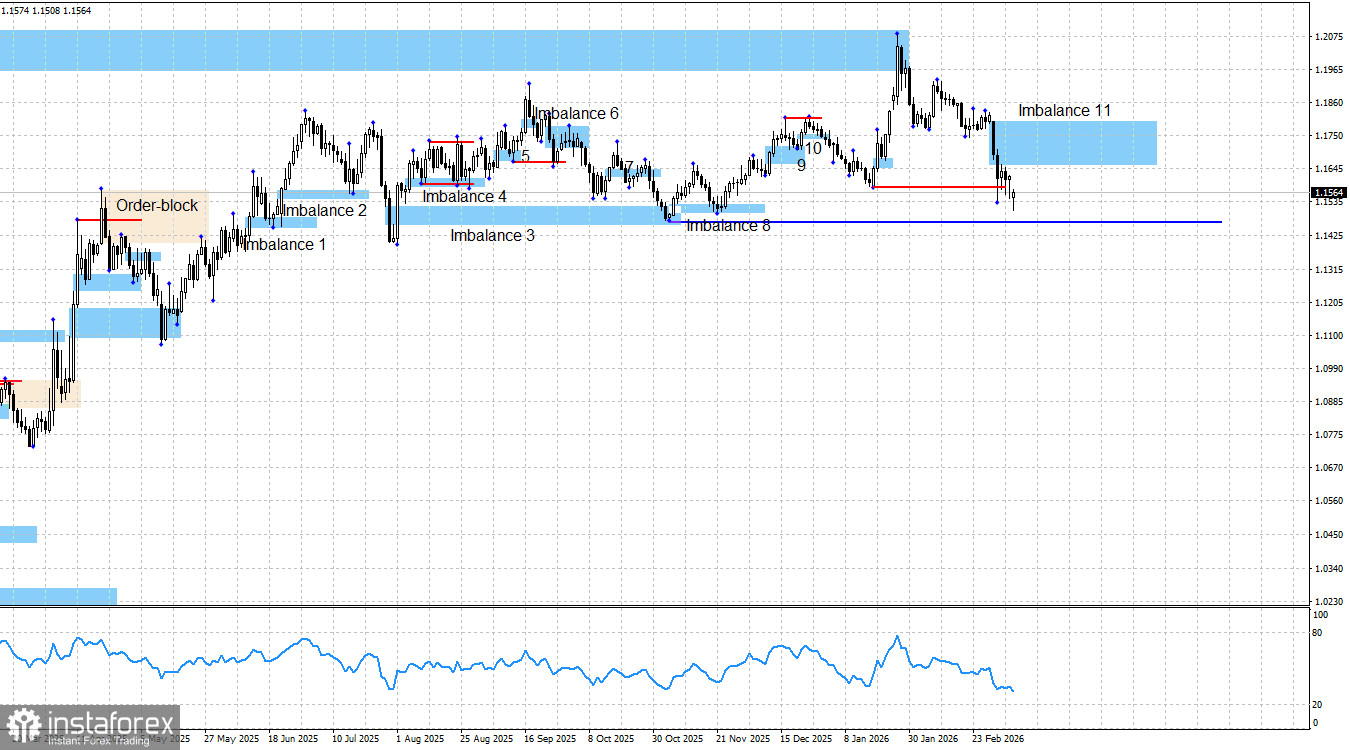
Last week, as expected, a bearish imbalance 11 was formed. However, the trend still remains bullish, and there has been no reaction to this pattern. Thus, regardless of the direction in which the European currency moves, there are currently no signals to open trades on the daily chart.
The graphical picture still indicates bullish dominance. The bullish trend remains, but at the moment bullish traders see no reasons for a new offensive. In order to expect growth of the European currency, the war in Iran must begin to ease, and the prices of oil and gas must decline. To open new buy trades, traders need new bullish patterns or at least a liquidity sweep from the last two bearish swings.
The news background on Monday was quite limited, but it should be remembered that last Friday traders ignored the Nonfarm Payrolls and unemployment rate reports. Thus, it currently does not matter whether there are important publications during the day. The pair is moving under the influence of completely different factors — geopolitical and energy-related ones.
In recent months bulls have had a huge number of reasons to attack, and even the start of the war in the Middle East has not reduced them. Structurally and globally, Trump's policies, which led to a significant fall of the dollar last year, have not changed. In the near term the U.S. currency may show growth amid investors fleeing risk, but this factor will not be able to support it permanently. Meanwhile, the dovish outlook for FOMC monetary policy, Trump's trade war with the rest of the world, the weakness of the U.S. labor market, two government shutdowns, U.S. military aggression, the criminal prosecution of Jerome Powell, slowing GDP growth, and other unpleasant developments for the United States are not canceled by the conflict with Iran.
I still do not believe in a bearish trend. The dollar has received temporary support from the market, but it is not certain that this situation will last long. The blue line shows the price level below which the bullish trend can be considered finished. Bears still need to move about 90 points downward to reach it, and even if they manage to accomplish this task, I will still doubt the emergence of a bearish trend. In my opinion, the pair is demonstrating a strong decline only because of the geopolitical factor. Once it stops influencing the market, what will bears rely on for further attacks?
News calendar for the United States and the European Union:
On March 10, the economic calendar contains three secondary entries. The influence of the news background on market sentiment on Tuesday will be extremely weak or absent. Friday showed that the market is not yet ready to sell the dollar.
EUR/USD forecast and trading advice:
In my opinion, the pair remains in the stage of forming a bullish trend. The news background changed direction sharply a week ago, but the trend itself remains intact. Thus, in the near future traders need new patterns and signals to form short-term forecasts. If these are bearish signals (which is more likely), it is important to remember that the trend remains bullish and that the geopolitical factor usually does not have a long-term impact. If they are bullish signals (which would be much more preferable), traders will have the opportunity to open new buy trades that do not contradict the prevailing trend.


