
Vea también


 18.12.2025 07:08 PM
For GBP/USD, the wave pattern continues to indicate the formation of an upward trend segment (lower chart), but over the past six months it has taken on a complex and extended form (upper chart). The trend segment that began on July 1 can be considered wave 4, or any large corrective wave, since it clearly has a corrective rather than an impulsive internal wave structure. The same applies to its internal sub-waves. The downward wave structure that started on September 17 took the form of a five-wave pattern a–b–c–d–e and has been completed. The instrument is now in the process of forming a new upward wave sequence.
Of course, any wave structure can become more complex and extended at any moment. Even the presumed wave 4, which has already been forming for six months, could take on a five-wave form, in which case we would observe correction for several more months. However, at this time, an upward wave sequence has every chance of developing. If this is indeed the case, the first two waves of this segment have already been formed, and we are now observing the formation of wave 3 or wave c, which is taking on an impulsive form and gives hope for an impulsive nature of the current wave sequence.
The GBP/USD exchange rate remained virtually unchanged throughout Thursday. Most likely, we will still see significant price movements by the end of the day, but I believe that the majority of market participants had expected stronger moves by this point. However, the meetings of the Eurozone and UK central banks ended exactly as most traders had expected. The ECB kept interest rates unchanged, while the Bank of England cut its rate by 25 basis points. Yesterday, I said that the BoE's decision to cut rates was likely already priced in, as it was obvious even before the inflation report. Even the MPC vote came without surprises—five policymakers voted in favor of a rate cut, exactly as expected. Therefore, neither of these events revealed any discrepancy between expectations and reality.
Accordingly, the most significant event of the day was not the ECB or the Bank of England meetings, but the U.S. inflation report. This report opens up new "dovish" prospects for the Federal Reserve, much to the delight of Donald Trump. Let me remind you that the labor market in October–November did not show growth or recovery that would allow the Fed to take a pause, and the unemployment rate jumped straight to 4.6%, something no one in the market expected. Consequently, if the FOMC decides to carry out another round of easing in January, there will be nothing surprising about it. That said, the Bank of England also received grounds yesterday to continue easing policy. However, the Bank of England does not have a Donald Trump demanding rate cuts down to ECB levels.
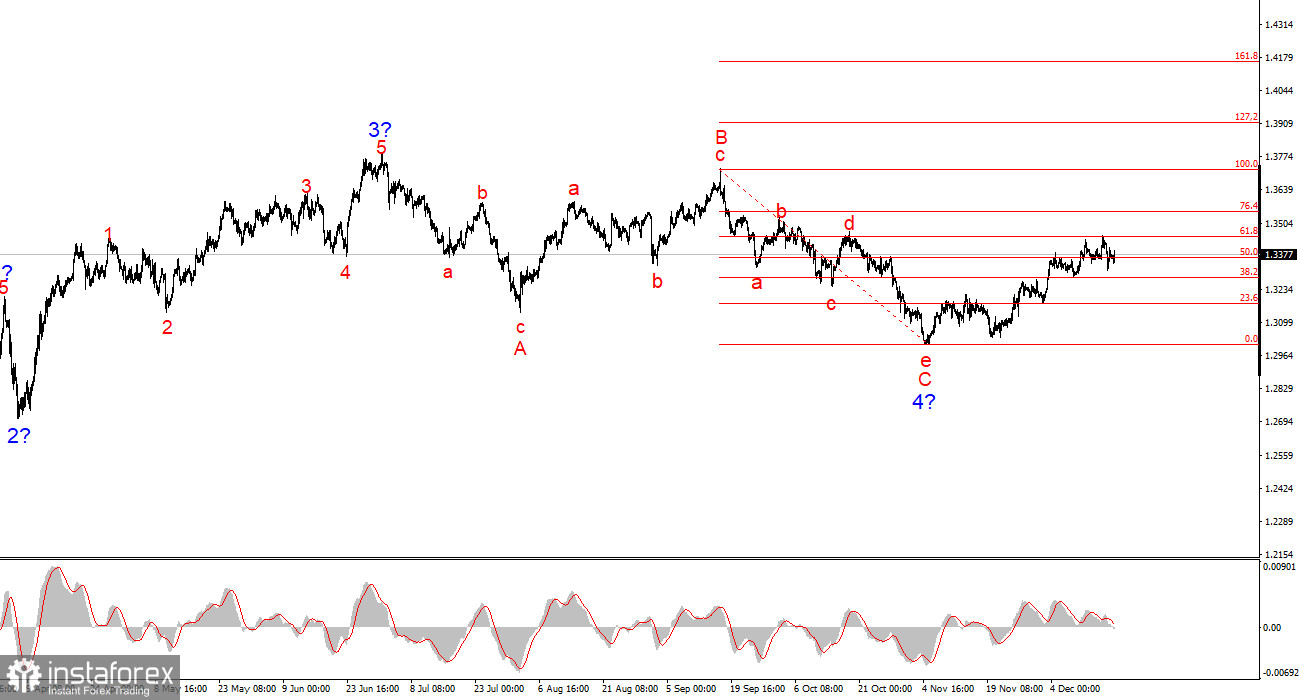
The wave picture for GBP/USD has changed. We continue to deal with an upward, impulsive trend segment, but its internal wave structure has become complex. The downward corrective structure a–b–c–d–e within C of wave 4 appears complete, as does wave 4 as a whole. If this is indeed the case, I expect the main trend segment to resume its development with initial targets around the 3.8000 and 4.0000 levels.
In the short term, I expected the formation of wave 3 or wave c with targets located near 1.3280 and 1.3360, which correspond to the 76.4% and 61.8% Fibonacci levels. These targets have been reached. Wave 3 or wave c continues to develop, and the current wave sequence is beginning to take on an impulsive character. Therefore, further gains can be expected, with targets around 1.3580 and 1.3630.
The higher-timeframe wave structure looks almost perfect, even though wave 4 moved beyond the high of wave 1. However, I would like to remind you that ideal wave structures exist only in textbooks—real market conditions are far more complex. At this time, I see no grounds for considering alternative scenarios to the bullish trend segment.


