
Veja também


 09.09.2026 06:11 PM
Review of Trades and Trading Tips for the European Currency
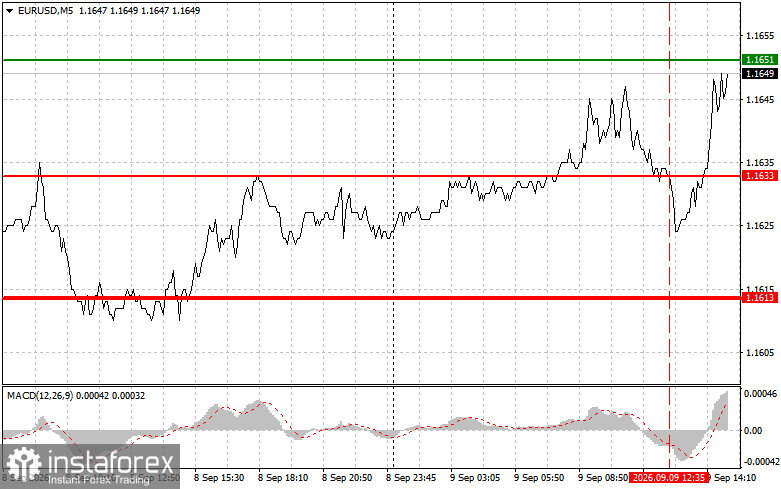
The test of the 1.1633 price level occurred when the MACD indicator had moved significantly below the zero line, limiting the pair's downward potential. For this reason, I did not sell the euro.
July statistics on French industrial production were frankly weak, prompting the euro to decline, as the weakness was broad-based. Transport equipment manufacturing once again performed the worst, losing almost another 3% after an equally deep decline in June, while the other segments, from metallurgy and chemicals to electronics, also moved into negative territory. This is a worrying signal, since the manufacturing sector should have reflected the recovery indicated by survey-based indicators such as PMI and Ifo, but actual output has yet to match those expectations. Ahead of tomorrow's ECB meeting, where a rate increase to 2.5% is almost fully priced in, the report merely highlights the gap between upbeat sentiment and sluggish production. In my view, this is a neutral-to-negative backdrop for the euro, and until the central bank's decision, the EUR/USD pair will most likely focus not on the French figures but on rate expectations and the ECB's tone.
The pair will spend the second half of the day waiting only for the weekly ADP employment report, and I would not overestimate its importance. The indicator reflects hiring dynamics, but in the current environment, with the market focused on inflation, even strong figures are unlikely to drive the dollar significantly higher. The latest labor-market releases clearly demonstrate this, as the US currency has reacted to them with surprisingly little movement. I consider this backdrop relatively favorable for the single currency, since without a strong dollar response, pressure on EUR/USD should remain limited. Much more important for the euro right now is the upcoming ECB decision, where a rate increase is almost fully priced in, and it—not the ADP report—will determine the pair's subsequent direction.
As for the intraday strategy, I will focus more on the implementation of Scenarios #1 and #2.
Buy Signal
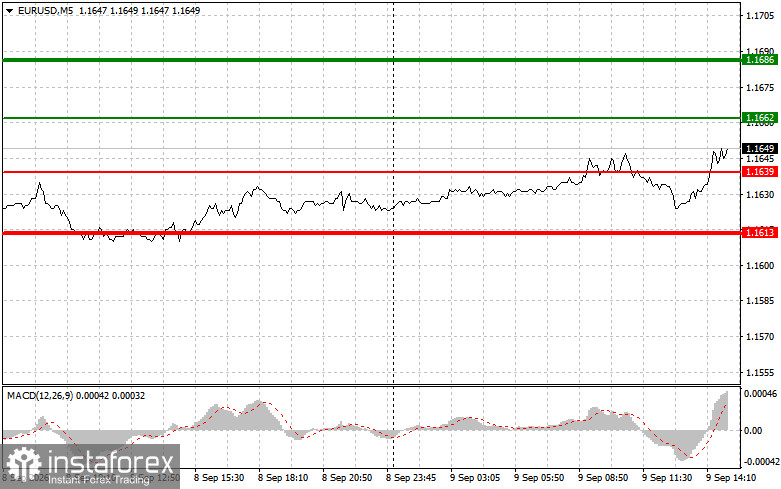
Scenario #1: Today, the euro can be bought when the price reaches around 1.1662 (the green line on the chart), with a target of 1.1686. At 1.1686, I plan to exit the market and also sell the euro in the opposite direction, targeting a move of 30–35 points from the entry point. The euro can be expected to rise today only after weak US data. Important! Before buying, make sure that the MACD indicator is above the zero line and is just beginning to rise from it.
Scenario #2: Today, I also plan to buy the euro if the price tests 1.1639 twice consecutively while the MACD indicator is in the oversold zone. This will limit the pair's downward potential and trigger a reversal higher. A rise toward the opposite levels of 1.1662 and 1.1686 can be expected.
Sell Signal
Scenario #1: I plan to sell the euro after the price reaches 1.1639 (the red line on the chart). The target will be 1.1613, where I plan to exit the market and immediately buy in the opposite direction, targeting a move of 20–25 points in the opposite direction from the level. Pressure on the pair will return if the data are strong. Important! Before selling, make sure that the MACD indicator is below the zero line and is just beginning to decline from it.
Scenario #2: Today, I also plan to sell the euro if the price tests 1.1662 twice consecutively while the MACD indicator is in the overbought zone. This will limit the pair's upward potential and trigger a reversal lower. A decline toward the opposite levels of 1.1639 and 1.1613 can be expected.
What the Chart Shows:
Important. Beginner Forex traders should be extremely cautious when making market-entry decisions. Before important fundamental reports are released, it is best to stay out of the market to avoid being caught in sharp exchange-rate fluctuations. If you decide to trade during news releases, always use stop orders to minimize losses. Without stop orders, you can lose your entire deposit very quickly, especially if you do not use proper money management and trade with large volumes.
And remember that successful trading requires a clear trading plan, such as the one presented above. Making trading decisions spontaneously based on the current market situation is an inherently losing strategy for an intraday trader.


