
Veja também


 29.09.2026 01:36 PM
Analysis of Trades and Trading Advice for the Japanese Yen
The test of the 157.57 price level occurred when the MACD indicator had just started moving up from the zero line, confirming the validity of the entry point for a long position on the dollar. However, the pair did not make a significant upward move.
The reason is that the yen has recently been receiving fundamental support. As I noted earlier, Japan's finance minister held talks with the U.S. side and reached an agreement on supporting the national currency's exchange rate. This fundamentally changes the situation for the USD/JPY pair, as any sustained upward move will now encounter not only technical resistance levels but also a very real political ceiling. Under these conditions, the risk of currency intervention is no longer an abstract threat but has become a restraining factor that market participants must incorporate into their calculations.
Against this backdrop, U.S. data in the second half of the day are particularly important for the yen. The U.S. Consumer Confidence Index and housing price index could temporarily support the dollar if they exceed expectations, but the upward potential for USD/JPY is now limited by diplomatic agreements and the threat of intervention. Speeches by Bowman, Barr, and Waller could add volatility, but in my view, a sustained breakout above key levels should not be expected. The market is likely to act more cautiously, bearing in mind that Japanese authorities are not acting alone this time.
As for the intraday strategy, I will focus primarily on the implementation of Scenarios No. 1 and No. 2.
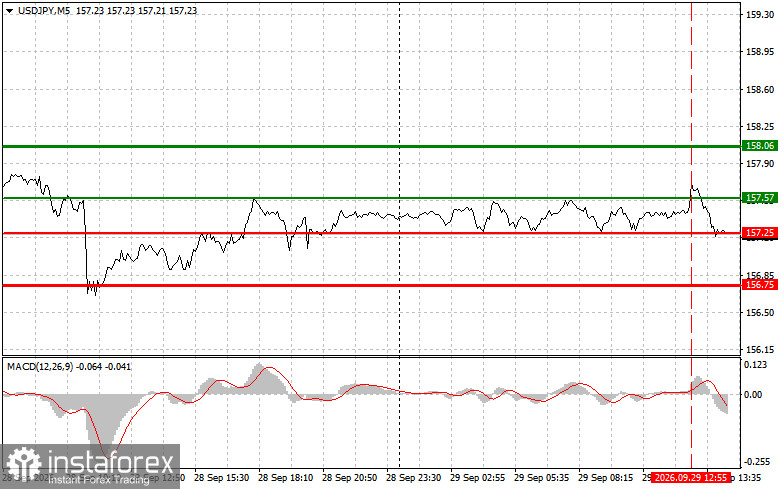
Buy Signal
Scenario No. 1: Today, I plan to buy USD/JPY when the entry point is reached around 157.40 (the green line on the chart), targeting a rise toward 157.85 (the thicker green line on the chart). Around 157.79, I will exit the long position and open a short position in the opposite direction, targeting a move of 30–35 points from the level. A rise in the pair can be expected today, but its potential is quite limited. Important! Before buying, make sure that the MACD indicator is above the zero line and is just beginning to rise from it.
Scenario No. 2: Today, I also plan to buy USD/JPY if the price tests 157.15 twice consecutively while the MACD indicator is in the oversold zone. This would limit the pair's downward potential and lead to a reversal higher. A rise toward the opposite levels of 157.40 and 157.79 can be expected.
Sell Signal
Scenario No. 1: Today, I plan to sell USD/JPY after the 157.15 level is broken (the red line on the chart), which should lead to a rapid decline in the pair. The key target for sellers will be 156.75, where I will exit the short position and immediately open a long position in the opposite direction, targeting a move of 20–25 points from the level. Downward pressure on the pair will return today if the central bank intervenes. Important! Before selling, make sure that the MACD indicator is below the zero line and is just beginning to decline from it.
Scenario No. 2: Today, I also plan to sell USD/JPY if the price tests 157.40 twice consecutively while the MACD indicator is in the overbought zone. This would limit the pair's upward potential and lead to a reversal lower. A decline toward the opposite levels of 157.15 and 156.75 can be expected.
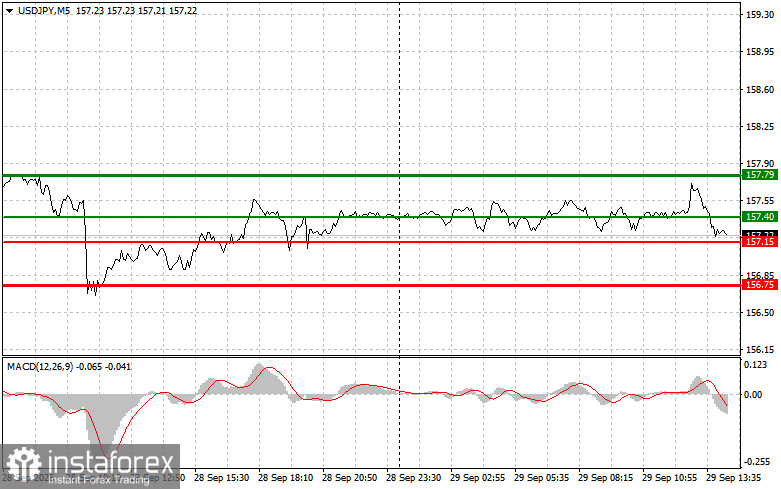
What the Chart Shows:
Important. Beginner Forex traders need to be very cautious when making decisions about entering the market. Before the release of important fundamental reports, it is generally preferable to stay out of the market to avoid exposure to sharp exchange-rate fluctuations. If you decide to trade during news releases, always place stop orders to minimize losses. Without stop orders, you can lose your entire deposit very quickly, especially if you do not use proper money management and trade large volumes.
And remember that successful trading requires a clear trading plan, such as the one presented above. Making spontaneous trading decisions based on the current market situation is, from the outset, an unsuccessful strategy for an intraday trader.


