
Veja também


 04.08.2026 09:39 AM
Bitcoin and Ethereum showed decent growth in the second half of the day yesterday, returning to the battle for key levels.

Meanwhile, Bitmine Immersion Technologies, led by Tom Lee, purchased another 10,399 Ethereum for $19.5 million, bringing its reserve to 5,797,813 coins worth about $10.8 billion, which corresponds to approximately 4.8% of the asset's total circulating supply. About 85% of all coins remain in staking, with 4,917,189 ETH at $9.2 billion, keeping the portfolio structure unchanged compared to previous company disclosures.
A much more concerning signal lies in another line of the report. The free cash and liquid securities for further purchases decreased to $173 million from $555 million, as recorded just a week earlier. Such a sharp reduction of the liquidity cushion—almost threefold in such a short period—raises questions about the pace at which the company can continue its accumulation unless it attracts new capital through the stock market.
Currently, the company's unrealized loss stands at $8.68 billion, which aligns with the trend that has plagued Bitmine for nearly its entire existence as an Ethereum treasury. Losses have fluctuated from $6 billion in February to $7.35-7.5 billion by May, then jumped to $8.9-9.3 billion in June and July amid Ethereum prices falling below $1,800, and have now slightly decreased alongside July's recovery of the asset by almost 20%. Even with this rebound, the company remains deeply underwater, with the average acquisition price of the first 3.7 million tokens exceeding $4,000 per coin—a level that Ethereum's current price has not reached, even during the year's best monthly growth.
As for short-term trading, the strategy and conditions are described below.
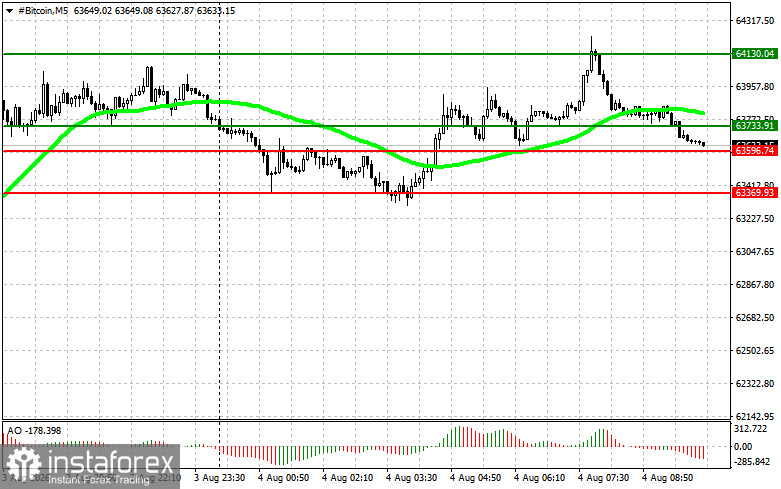
Scenario #1: I will buy Bitcoin today upon reaching an entry point around $63,700 with a target growth to $64,100. At $64,100, I plan to exit the buy positions and sell immediately on the bounce. Before buying on a breakout, ensure that the 50-day moving average is below the current price and the Awesome indicator is above zero.
Scenario #2: I can buy Bitcoin from the lower boundary at $63,500 if there is no market reaction to its breakout back toward the levels of $63,700 and $64,100.
Scenario #1: I will sell Bitcoin today upon reaching an entry point around $63,500 with a target drop to $63,300. At $63,300, I plan to exit the sell positions and buy immediately on the bounce. Before selling on a breakout, ensure that the 50-day moving average is above the current price and the Awesome indicator is below zero.
Scenario #2: I can sell Bitcoin from the upper boundary at $63,700 if there is no market reaction to its breakout back toward the levels of $63,500 and $63,300.
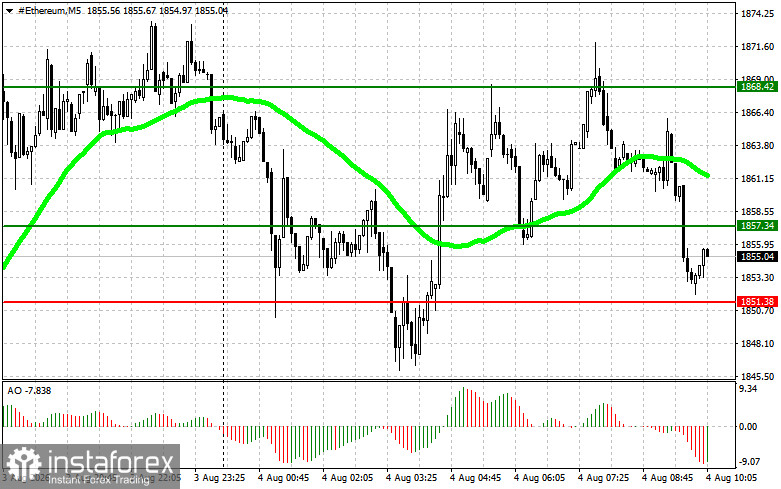
Scenario #1: I will buy Ethereum today upon reaching an entry point around $1,857 with a target growth to $1,868. At $1,868, I plan to exit the buy positions and sell immediately on the bounce. Before buying on a breakout, ensure that the 50-day moving average is below the current price and the Awesome indicator is above zero.
Scenario #2: I can buy Ethereum from the lower boundary at $1,851 if there is no market reaction to its breakout back toward the levels of $1,857 and $1,868.
Scenario #1: I will sell Ethereum today upon reaching an entry point around $1,851 with a target drop to $1,841. At $1,841, I plan to exit the sell positions and buy immediately on the bounce. Before selling on a breakout, ensure that the 50-day moving average is above the current price and the Awesome indicator is below zero.
Scenario #2: I can sell Ethereum from the upper boundary at $1,857 if there is no market reaction to its breakout back toward the levels of $1,851 and $1,841.


