
Veja também


 24.07.2026 07:51 AM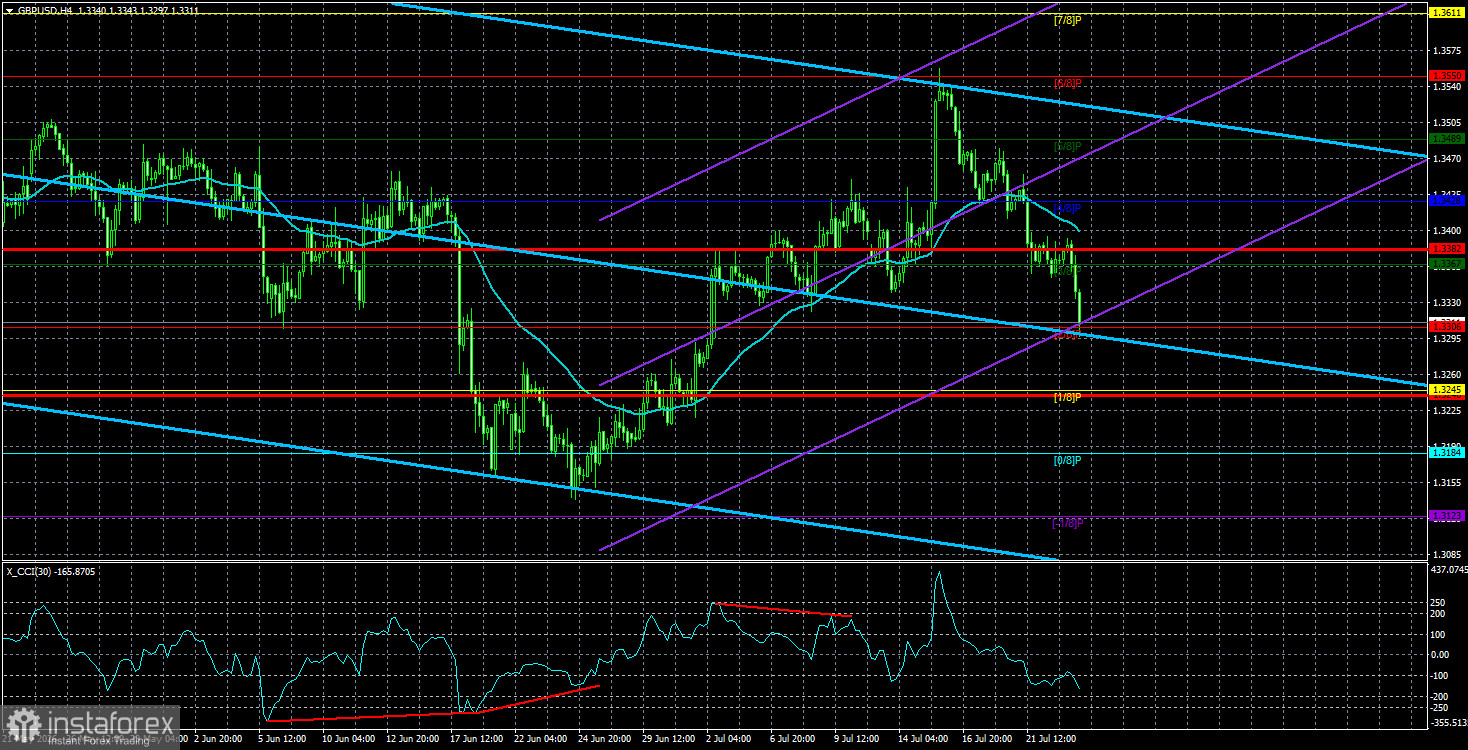
The GBP/USD currency pair continued its downward movement on Thursday, although the British currency had even less reason to decline than the euro. We saw a decent rise in the British currency over the last few weeks, followed by a purely technical correction that coincided with a weak inflation report from the UK, which significantly lowered the likelihood of tightening monetary policy by the Bank of England. Everything is quite logical, and the British pound has not been stagnant in recent weeks, unlike the euro.
Yesterday, the decline continued, even though there were no reports or events in either the UK or the US. In simple terms, the British pound was unable to pull the euro up with it, while the euro was easily pulled down by the pound. What can we expect from the British pound going forward? In principle, the euro may continue to decline for some time, as the market is clearly set for a new wave of sell-offs. At the same time, the British pound may also decrease, but its prospects are much more positive. It feels like the pound and euro should converge at some point, from which both can begin a new upward trend. To reiterate: there are no grounds for the US dollar to rise. It was clear a month ago that the conflict in the Middle East would continue for a long time.
Formally, geopolitics could drive the dollar to new heights. The blockade of the Bab-el-Mandeb Strait may soon join the blockade of the Strait of Hormuz, and then oil prices could "catch" somewhere around $150 per barrel. It is already known that Yemeni Houthis are attacking Saudi tankers in the Red Sea, so the maritime blockade of Saudi Arabia has effectively begun. Donald Trump was unable to open the Strait of Hormuz, and there is no hope that he will be able to open the Bab-el-Mandeb Strait. What can the American president do? Start bombing Yemen as well? As everyone has already realized, military pressure yields no results. It only makes things worse. And making things worse is something Trump excels at.
Thus, in general, the dollar may continue to strengthen if the conflict in the Middle East continues to escalate in territorial terms. The dollar will rise, even though Trump does not need that. The Federal Reserve will tighten policy, even though Trump does not need that. Such are the results of the military operation led by the White House, which was also unnecessary for anyone. Most Americans still do not understand why there is a need for a war with Iran, and in a couple of months they will start paying $6 per gallon for fuel instead of $4.50. In principle, it can be assumed that the Republican Party has already lost the upcoming US Congressional elections. Once the results are officially recorded, it will be possible to understand how the situation in the Middle East will develop further. In 2026, only geopolitics supports the dollar. If it weren't for that, the British pound would already be valued at $1.4000.
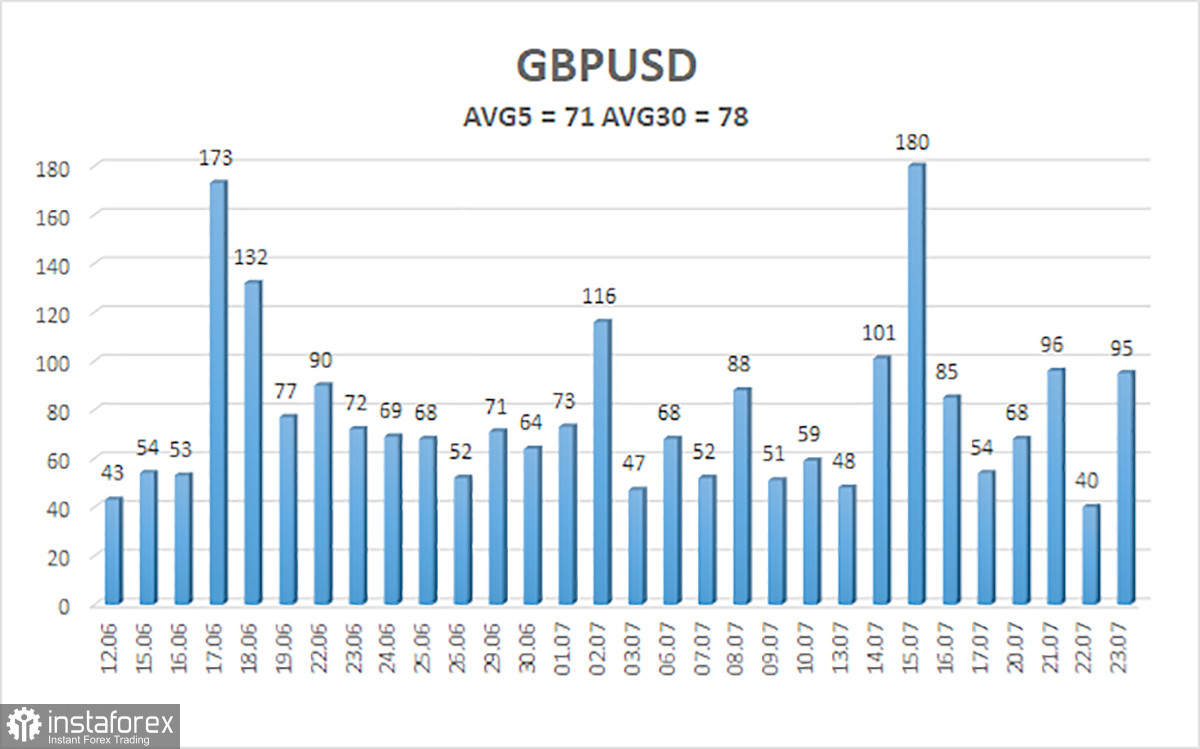
The average volatility of the GBP/USD pair over the last 5 trading days is 71 pips. For the pound/dollar pair, this value is considered "average." On Friday, July 24, we therefore expect movement within the range limited by the levels of 1.3240 and 1.3382. The upper channel of linear regression is directed downwards, indicating a downward trend. The CCI indicator has formed a bearish divergence and has entered the overbought area – a downward correction has begun.
S1 – 1.3306
S2 – 1.3245
S3 – 1.3184
R1 – 1.3367
R2 – 1.3428
R3 – 1.3489
The GBP/USD currency pair maintains an upward trend. Donald Trump's policies will continue to exert pressure on the US economy, so we do not expect long-term growth from the American currency. The year 2026 is shaping up to be super positive for the dollar due to geopolitics, but every fairy tale comes to an end. However, on the weekly timeframe, there is still a flat trend between the levels of 1.3150 and 1.3780 within the framework of a four-year uptrend, which allows for the expectation of continued growth of the British currency in the medium term. Long positions with targets of 1.3489 and 1.3550 can be considered when the price is above the moving average. The placement of the price below the moving average line allows for short positions with targets of 1.3245 and 1.3240.
Linear regression channels help determine the current trend. If both are pointing in the same direction, the trend is currently strong;
The moving average line (settings 20,0, smoothed) defines the short-term trend and the direction in which trading should currently be conducted;
Murray levels are target levels for movements and corrections;
Volatility levels (red lines) indicate the probable price channel within which the pair will operate in the next 24 hours based on current volatility indicators;
The CCI indicator – its entry into the oversold area (below -250) or the overbought area (above +250) means that a trend reversal in the opposite direction is imminent.


