
یہ بھی دیکھیں


 25.09.2026 09:02 AM
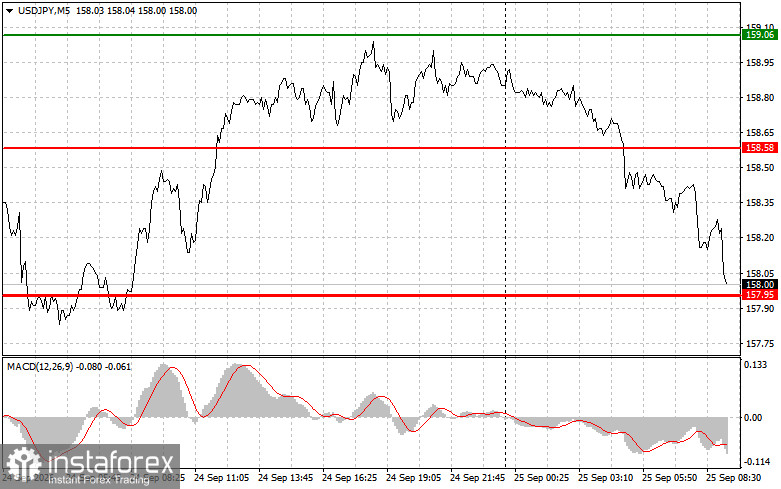
I did not reach the levels I marked yesterday, so I had no trades.
US housing data were mixed. The report showed new-home sales in August rose 6.4% month-on-month to a 684k annualized pace, but the median sale price fell 9.1%. A similar ambiguity appeared in labor-market data: initial jobless claims fell to 197k while continuing claims edged up slightly to 1.719 million.
Against that backdrop, the yen received a much stronger reason to firm from the Japanese side. Japan's core CPI accelerated to 1.8% year-on-year in August (consensus 1.5%, July 1.6%), noticeably beating expectations. The Bank of Japan also published a fresh report on core inflation indicators showing that price pressures are broadening. A three-dimensional set of adjusted measures continues to rise and is holding above levels seen in the past decade. Core inflation measures remain noticeably above the BoJ's 2% target, confirming the inflationary process appears sustained rather than transitory. After that release, the yen returned to strength, since the combination of stronger-than-expected core CPI and broadening price pressure strengthens the case for a more decisive policy normalization by the Japanese central bank.
For USD/JPY, the pause in dollar strength became particularly sensitive, especially as the yen remains near the psychologically important 160 level and Japan is just returning from holidays, increasing attention to the risk of currency intervention. I believe that now — when US data fail to provide the pair with additional fuel for gains while Japanese data bolster hawkish BoJ expectations — the threat of official intervention from Tokyo becomes a far more significant factor than the usual yield-differential story. Further USD/JPY dynamics will likely hinge more on Japan authorities' willingness to act and confirmation of a hawkish BoJ stance at upcoming meetings than on today's mixed US releases.
For intraday strategy, I will mainly rely on executing Scenarios No. 1 and No. 2.
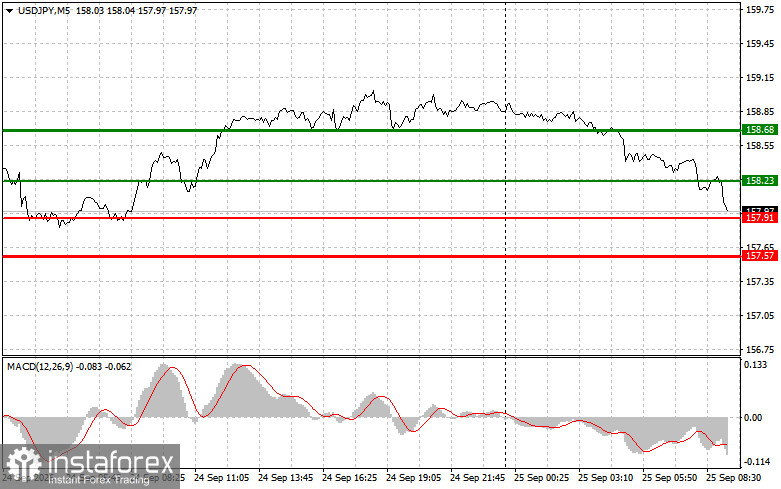
No 1: I plan to buy USD/JPY today around 158.23 (green line on the chart), targeting 158.68 (thicker green line on the chart). Around 158.68, I plan to exit long positions and open short positions in the opposite direction (expecting a 30–35 pip counter-move). It is best to return to buying the pair on corrections and significant pullbacks. Important: before buying, ensure the MACD indicator is above zero and has just begun rising.
No 2: I also plan to buy USD/JPY if the price tests 157.91 twice in a row while MACD is in the oversold area. This would limit downside potential and lead to an upward reversal. Expect moves to 158.23 and 158.68.
No 1: I plan to sell USD/JPY today only after the 157.91 level is broken (red line on the chart), which should lead to a rapid decline in the pair. The sellers' key target will be 157.57, where I plan to exit shorts and immediately open longs in the opposite direction (expecting a 20–25 pip counter-move). Sellers can return at any moment — it only takes any hint from the central bank. Important: before selling, ensure the MACD indicator is below zero and has just begun falling.
No 2: I also plan to sell USD/JPY if the price tests 158.23 twice in a row while MACD is in the overbought area. This would limit upside potential and trigger a downward reversal. Expect falls toward 157.91 and 157.57.
Important: Beginner traders in the Forex market need to be very cautious when making entry decisions. It is best to stay out of the market ahead of significant fundamental reports to avoid being caught in sharp price fluctuations. If you decide to trade during news releases, always set stop orders to minimize losses. Without stop orders, you can quickly lose your entire deposit, especially if you do not employ money management practices and trade large volumes.
Also, remember that successful trading requires a clear trading plan, similar to the one provided above. Making spontaneous trading decisions based on current market conditions is inherently a losing strategy for intraday traders.


