
यह भी देखें


 14.07.2026 08:55 AM
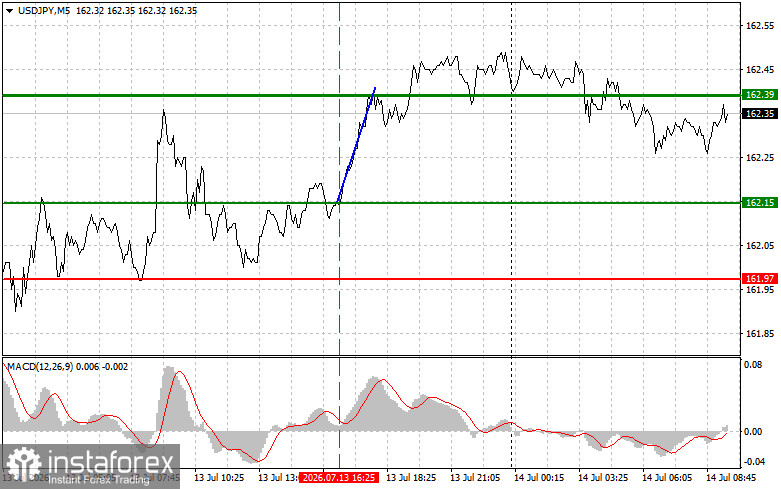
The price test at 162.15 coincided with the moment when the MACD indicator was just beginning to move upward from the zero mark, confirming the correct entry point for buying the dollar. As a result, the pair rose toward the target level of 162.39.
The maritime blockade of the Iranian coastline has become a new trigger for demand for safe-haven assets and has strengthened the dollar, once again putting pressure on the Japanese yen. Amid the escalation, Tehran hinted at withdrawing from the memorandum with Washington, while Yemen launched another wave of missiles at Saudi Arabia, increasing overall tension in the region. The Japanese yen finds itself caught between two fires in this context. As a traditional safe haven, it could benefit from a surge in anxiety, but the simultaneous strengthening of the dollar and the threat of rising oil prices play against Japan, which is nearly entirely dependent on energy imports. However, if the dollar's rise accelerates USD/JPY too quickly, the issue of currency intervention might resurface, as the Bank of Japan has repeatedly entered the market to curb excessive weakening of the national currency during such stressful episodes.
As for the intraday strategy, I will mainly rely on the implementation of scenarios #1 and #2.
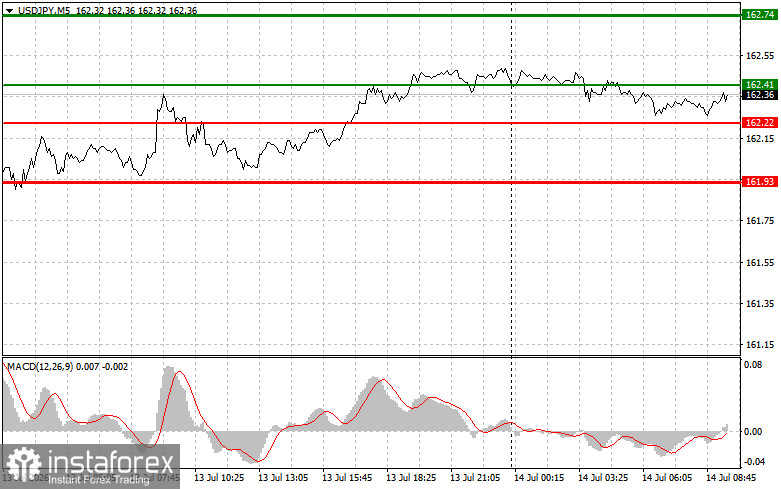
Scenario #1: I plan to buy USD/JPY today at the entry point around 162.41 (green line on the chart), with a target for growth to 162.74 (thicker green line on the chart). At around 162.74, I intend to exit my long positions and sell back immediately (expecting a movement of 30-35 pips in the opposite direction from the level). It is best to resume buying the pair during corrections and significant pullbacks in USD/JPY. Important! Before buying, ensure that the MACD indicator is above the zero mark and just beginning to rise from it.
Scenario #2: I also plan to buy USD/JPY today in the event of two consecutive tests of 162.22, with the MACD indicator in the oversold area. This will limit the pair's downward potential and lead to an upward market reversal. We can expect a rise to the opposite levels of 162.41 and 162.74.
Scenario #1: I plan to sell USD/JPY today only after the 162.22 level is updated (red line on the chart), which will lead to a rapid decline in the pair. The key target for sellers will be 161.93, where I plan to exit my short positions and immediately buy back (expecting a move of 20-25 pips in the opposite direction from that level). Sellers will return to the market at any moment; any hint from the central bank will suffice. Important! Before selling, ensure that the MACD indicator is below the zero mark and just beginning to decline from it.
Scenario #2: I also plan to sell USD/JPY today if there are two consecutive tests of the price at 162.41 when the MACD indicator is in the overbought area. This will limit the pair's upward potential and lead to a downward market reversal. We can expect a decline to the opposite levels of 162.22 and 161.93.
Important: Beginning traders in the Forex market must make entry decisions very cautiously. Before the release of significant fundamental reports, it is best to stay out of the market to avoid sudden price fluctuations. If you decide to trade during news releases, always set stop orders to minimize losses. Without stop orders, you can quickly lose your entire deposit, especially if you do not use money management and trade with large volumes.
And remember, for successful trading, it is necessary to have a clear trading plan, similar to the one I have presented above. Making spontaneous trading decisions based on the current market situation is fundamentally a losing strategy for intraday traders.

