
यह भी देखें


 21.04.2026 08:34 PM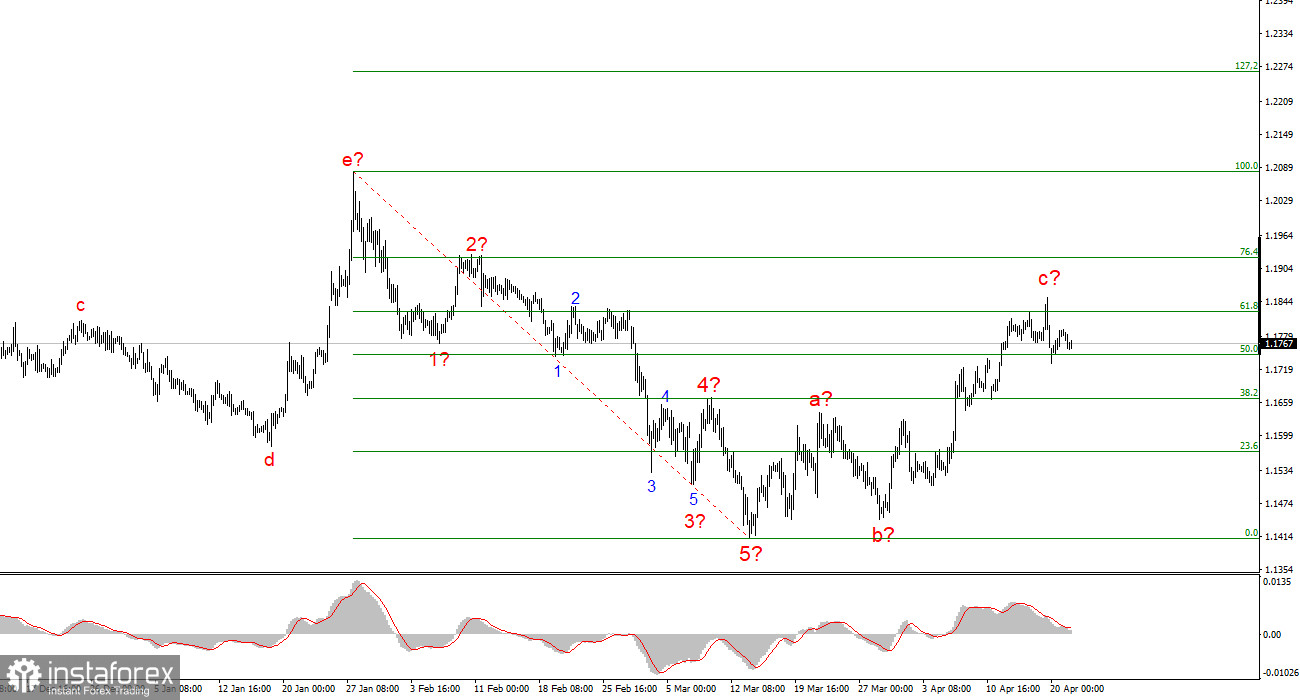
The wave pattern on the 4-hour chart for EUR/USD has evolved. There is still no talk of canceling the upward trend segment (lower chart), which began in January of last year, but the wave structure now looks quite ambiguous. In such situations, I always recommend switching to a lower timeframe (upper chart) and focusing on the simplest, smaller wave structures to make short-term forecasts, which is sufficient for opening trades. Wave structures can be very complex and allow for multiple scenarios. The easiest approach is to trade using standard "five-three" patterns.
In the chart above, a classic five-wave impulse structure with an extended third wave can be identified. If this is indeed the case, then the formation of this structure is complete, and a corrective sequence of at least three waves is now underway. Therefore, in the near term, an upward movement in quotes can be expected, but within a correction relative to the latest trend segment. So far, recent wave formations do not fit well into the higher-level structure, but the situation should become clearer over time. The euro's recovery may end near the 1.1824 level.
The EUR/USD pair showed almost no change during Tuesday, with very low volatility. Overall, the day was not rich in news, and the market is increasingly ignoring many reports and releases. For more than two months, economic data has been largely overlooked, as market participants consider geopolitics to be the dominant factor. At the same time, geopolitical news is often ignored as well, since it frequently consists of rumors or outright misinformation.
For example, consider the recent flow of headlines: on Friday, Donald Trump announced the reopening of the Strait of Hormuz; on Saturday, Iran stated that the blockade would remain; on Sunday, Trump announced a second round of negotiations in Islamabad; on Monday, Iran officially rejected the talks; and on Tuesday, reports emerged that negotiations would still take place. In theory, the market should have been swinging wildly throughout these developments. However, it appears that the market has learned from past experiences and is no longer reacting to every rumor.
The information suggesting that negotiations will take place this week remains unverified and unofficial. Some media sources claim that Iran's Supreme Leader Mojtaba Khamenei has approved the talks, while the Islamic Revolutionary Guard Corps opposes them. Therefore, before tomorrow, the market may receive additional reports about the cancellation or resumption of negotiations based on "insider" information. I would not take such reports seriously—and neither is the market. At the start of the week, traders are not eager to jump into trades, preferring to wait calmly for further developments.
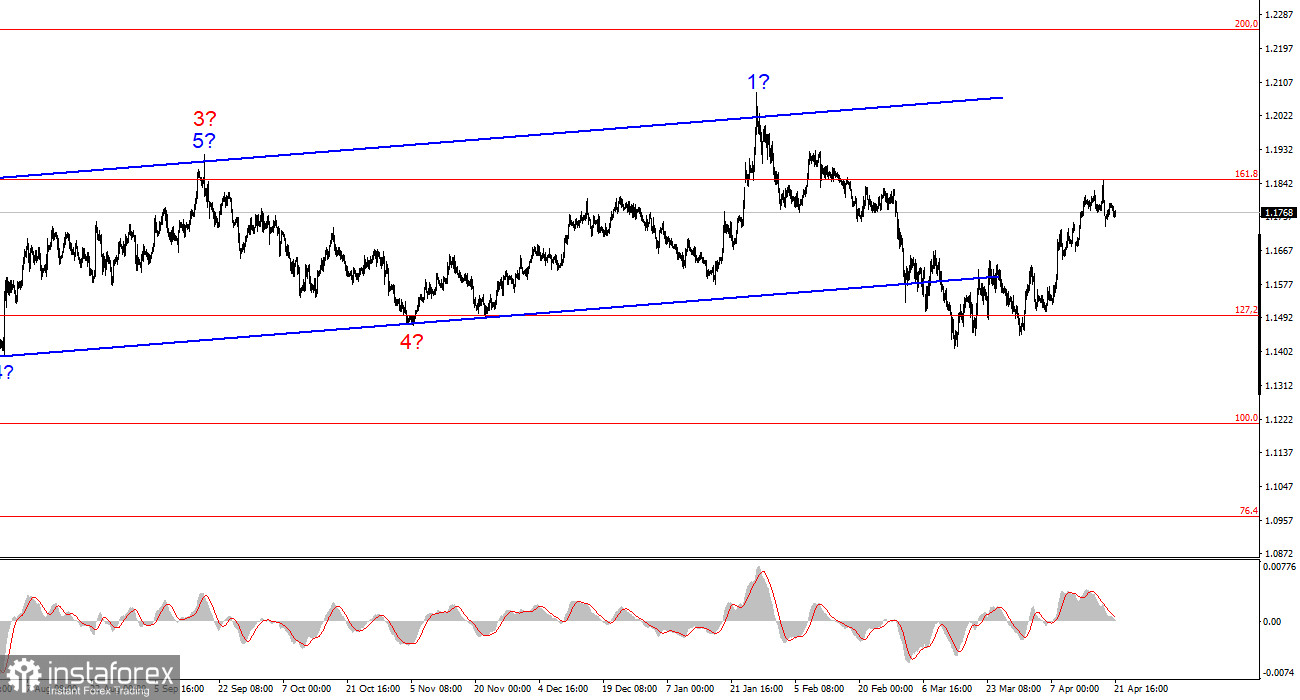
Based on the analysis of EUR/USD, I conclude that the instrument remains within an upward trend segment (lower chart), while in the short term it is within a corrective structure. The corrective wave pattern appears largely complete and could only become more complex and extended in one case—if a stable and long-term truce is established between Iran, the US, Israel, and all other Middle Eastern countries. Otherwise, I believe a new downward wave structure could begin from current levels, or at least a corrective wave.
On the lower timeframe, the entire upward trend segment is visible. The wave structure is not entirely standard, as corrective waves differ in size. For example, the higher-degree wave 2 is smaller than the internal wave 2 within wave 3. However, such cases do occur. I would like to emphasize that it is better to focus on clear and understandable structures rather than strictly labeling every wave. The trend may reverse in the near future.
Key Principles of My Analysis

