
यह भी देखें


 08.04.2026 07:21 AM
The situation in the cryptocurrency market remains unchanged. Last night, it was reported that Tehran and Washington reached an agreement on a two-week truce, which should support all risk assets and put pressure on the dollar, which has been rising solely on geopolitical factors over the past two months. In principle, this is exactly what happened. Bitcoin rose by $4,000, while the dollar lost about 100-150 points against its major competitors.
Now, let's look at the 4-hour time frame. What has changed? Nothing. We continue to observe a flat market. The price rose after deviating from the lower boundary of the sideways channel to the upper boundary and formed another deviation. Thus, Bitcoin could soon head back to the lower boundary of the sideways channel.
Bitcoin has been trading within a flat range for two full months. During this time, Donald Trump has prepared the world for war in Iran, bombed Iran along with Israel for five weeks, and then established a truce. Throughout this time, Bitcoin continued to trade in the sideways channel. How can we claim that "digital gold" reacts to geopolitics? Of course, we observe local market reactions from time to time, but globally, nothing changes for Bitcoin.
Thus, we continue to uphold our viewpoint. On the daily time frame, it is evident that a weak upward correction continues, which could end at any moment, as it has lasted for two months. The downward trend is not over, and there is no sign of an upward trend beginning. Liquidity below the trend line remains, and the $57,500 target has not been reached.
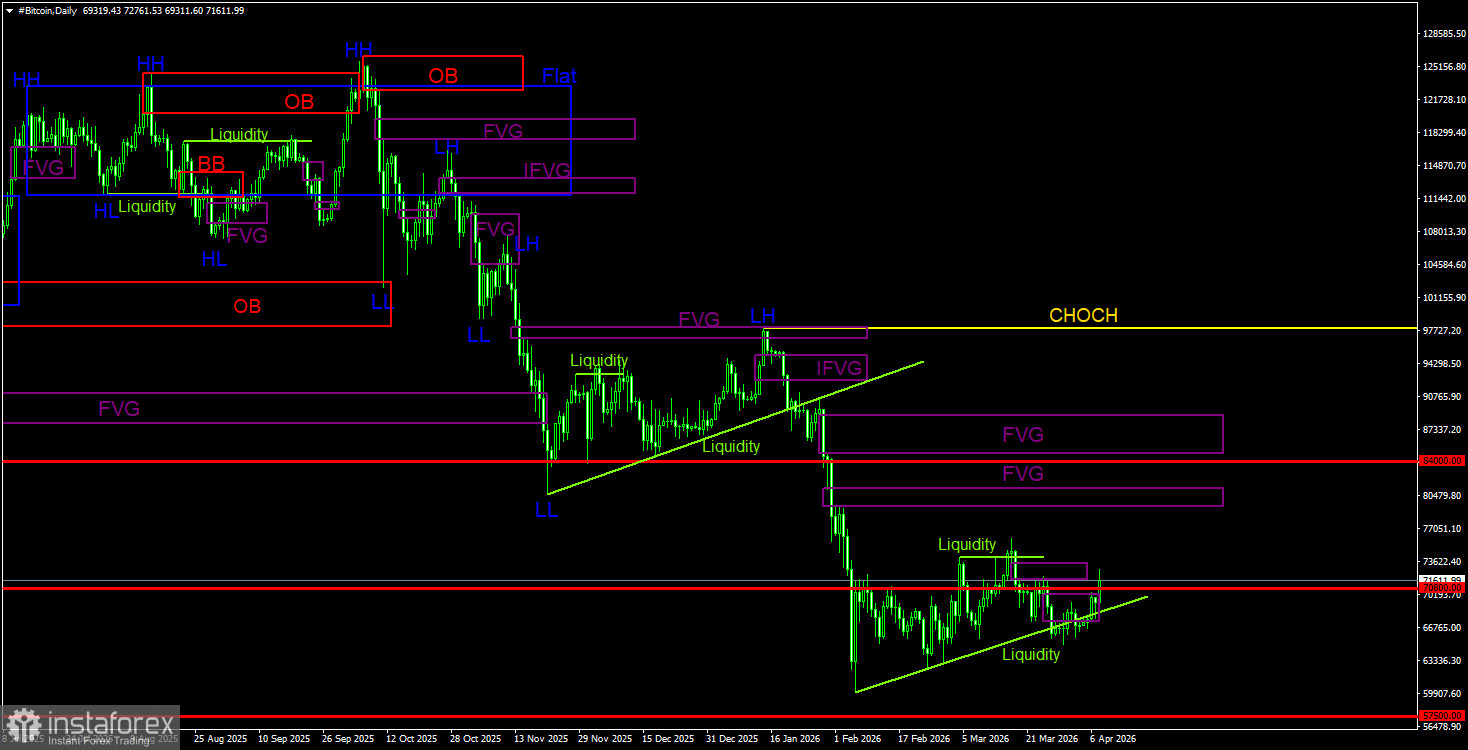
On the daily time frame, Bitcoin continues to form a downward trend. The trend structure is identified as descending, and the CHOCH line remains at $97,900. Only above this level can it be considered that the downward trend has ended. The last sell signal was formed within a "bearish" FVG ($96,900 – $98,000), providing traders a great opportunity to capture almost all of the recent downward movement. Now, we can only wait. Given no signs of a trend reversal to the upside, we believe the decline will resume. On the daily time frame, the nearest POI area for new sell trades is between $79,500 and $81,100. During the current decline, two bearish FVGs were formed with preliminary liquidity removal for sales; however, we see that the flat on the 4-hour time frame currently plays a more priority role.
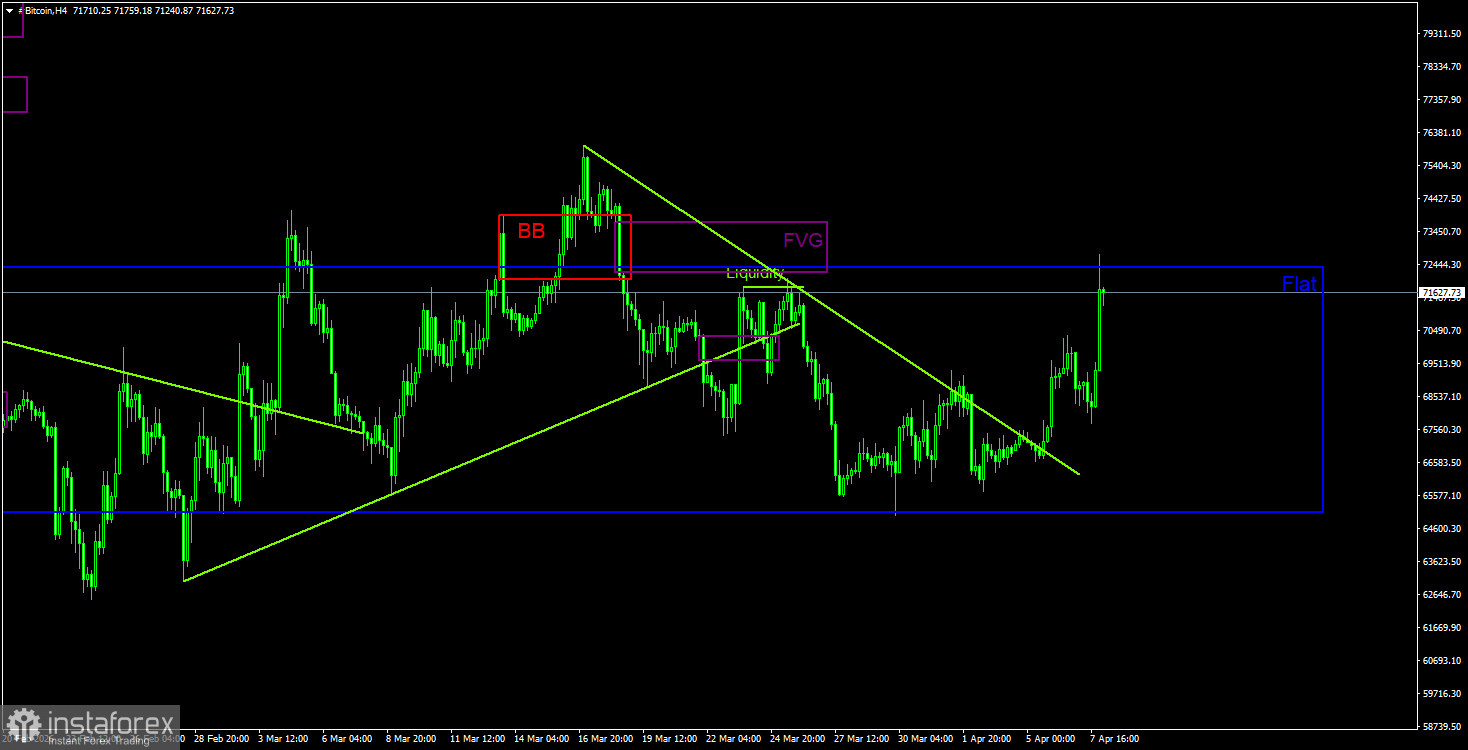
On the 4-hour time frame, the price has dropped to the lower boundary of the sideways channel, formed a deviation/rebound from it, and has risen to the channel's upper boundary. The flat persists, so all internal patterns are of no significance. We currently trust the daily chart more, but the flat on the 4-hour time frame defines the direction and strength of the movement. Once the flat ends, we can shift our focus to the daily time frame. On the 4-hour time frame, Bitcoin has already formed a deviation from the upper boundary, so it would be reasonable to anticipate a drop back towards the lower boundary of the channel soon.
Bitcoin continues to form a full-fledged downward trend and a correction against it. We continue to expect a decline, targeting $57,500 (the 61.8% Fibonacci level from a three-year upward trend), and there are currently no signs of a trend reversal. Even the level of $57,500 now does not look like the final stop. Among the POI areas, we can currently highlight only the nearest bearish FVG on the daily time frame, in the range of $79,300–$81,200. On the 4-hour time frame, Bitcoin's movement again shows all the signs of a flat, so only deviations from the boundaries of the sideways channel should be monitored. A new deviation has just been formed now.

