
यह भी देखें


 23.01.2026 12:49 AM
Everyone has already forgotten about the situation with Federal Reserve Board Governor Lisa Cook. It's hard to remember Trump's desire to fire Cook via social media when the first three weeks of the new year were filled with globally significant events. However, this week, a hearing took place in the Supreme Court, where "the fairest court in the world" tried to determine whether Donald Trump had the right to fire the FOMC governor. Spoiler: he does not.
However, the U.S. Supreme Court has yet to deliver a definitive verdict. Just as in the case of Trump's tariffs under the 1979 International Emergency Economic Powers Act, which does not mention the word "tariff" even once. Sometimes it may seem that the duties of the Supreme Court of the United States are not to follow the law, resolve contentious issues, establish the truth, and render verdicts, but rather to comment on what is happening, much like on social media. The Supreme Court justices could simply leave their comments under Trump's post in which he fired Cook, and that would be that.
I want to point out that until the fall of last year, no president in U.S. history had ever attempted to fire a Federal Reserve governor, which has existed since 1913. Trump decided to rectify this unfortunate oversight. In October, the court ruled to suspend Cook's firing until a final verdict is rendered in her case. I remind you that the president's administration accused Cook of alleged mortgage fraud several years ago.
At the same time, the hearing for Jerome Powell is ongoing, who is accused of misappropriations during the renovation of Federal Reserve buildings and giving false testimony to Congress. At this point, the court cannot find outright falsehoods in Powell's testimony, but it also cannot render a final verdict. As a result, we have three suspended cases involving Trump that could significantly impact the currency and financial markets: the Powell case, the Cook case, and the tariff case. Economists continue to sound the alarm, considering the loss of the Fed's independence and its apolitical stance a catastrophe for the American currency. Trust in the dollar has been steadily declining over the past year, and central banks around the world are working to reduce their dollar reserves. The further into the forest, the more firewood.
Based on the analysis of EUR/USD, I conclude that the instrument continues to form an upward trend. Donald Trump's policy and the Federal Reserve's monetary policy remain significant factors in the long-term decline of the American currency. The targets of the current trend segment may extend to the 25-figure. However, to achieve the targets, the market must clearly and irrevocably complete the formation of the extended wave 4. Currently, I am not confident that the last segment of the trend will take the form of a-b-c-d-e. Therefore, a decline to the 15 figure can still be expected.
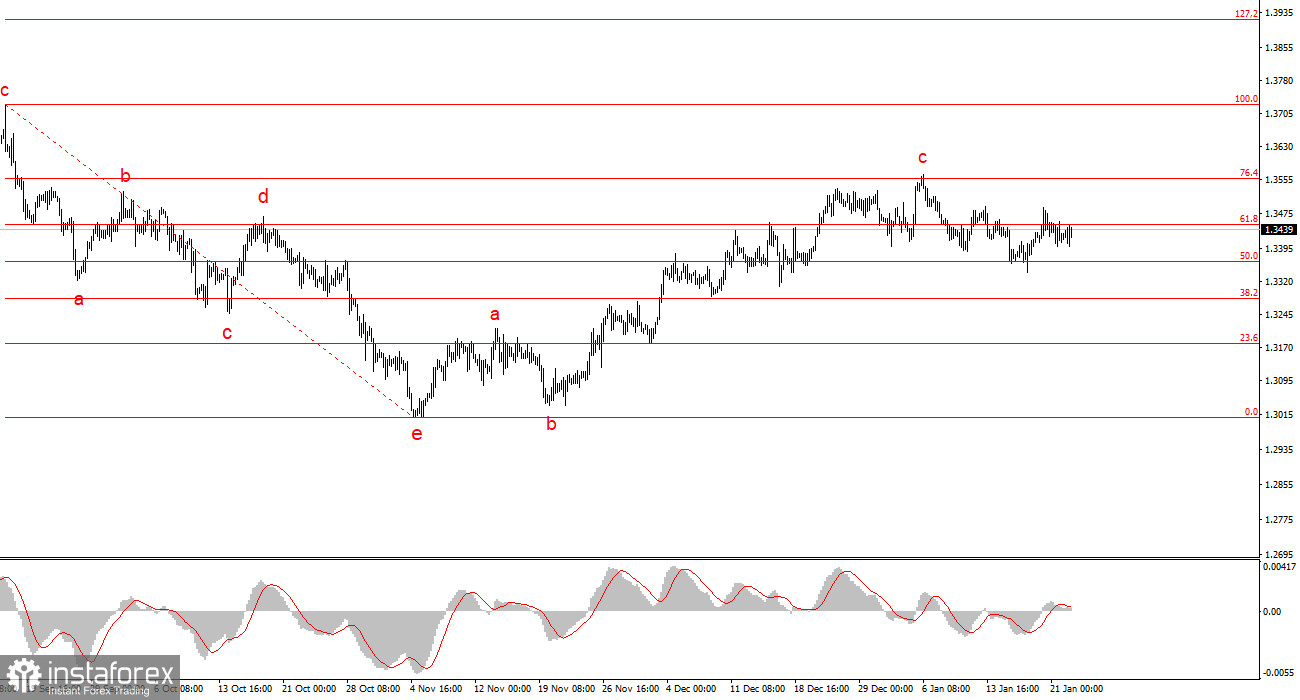
The wave picture for the GBP/USD instrument has changed. The downward corrective structure a-b-c-d-e in C of 4 appears complete, as does the entire wave 4. If this is indeed the case, I expect the main trend segment to resume its construction, with initial targets around the 38 and 40 levels. In the short term, I expected wave 3 or C to form, with targets around 1.3280 and 1.3360, which correspond to the 76.4% and 61.8% Fibonacci levels. These targets have been reached. Wave 3 or C is presumed to have completed its formation, so a downward wave or a set of waves may be observed in the near future.

