
আরও দেখুন


 10.09.2026 02:12 PM
Analysis of Trades and Trading Advice for the Japanese Yen
The price test of 153.72 occurred when the MACD indicator had already moved significantly above the zero line, limiting the pair's upward potential. For this reason, I did not buy the dollar.
Apparently, currency interventions have been put on hold, as the U.S. dollar recovered quite strongly against the yen during European trading today. As a reminder, in the second half of the day, market attention will be divided between the ECB meeting and U.S. economic data. For USD/JPY, the key releases will be the Producer Price Index and its core version, existing home sales, and initial jobless claims. The PPI serves as an early indicator of inflation, so if it comes in above forecasts, demand for the dollar may increase, leading to another rise in the pair. However, it is important to keep the current market situation in mind. In the opposite scenario, with low inflation, dollar weakness could instead lead to another strengthening of the yen. Nevertheless, without currency intervention, the pair is more likely to continue its gradual recovery, as major yen buyers are unlikely to become active before tomorrow's Consumer Price Index data.
As for the intraday strategy, I will focus more on the implementation of Scenarios No. 1 and No. 2.
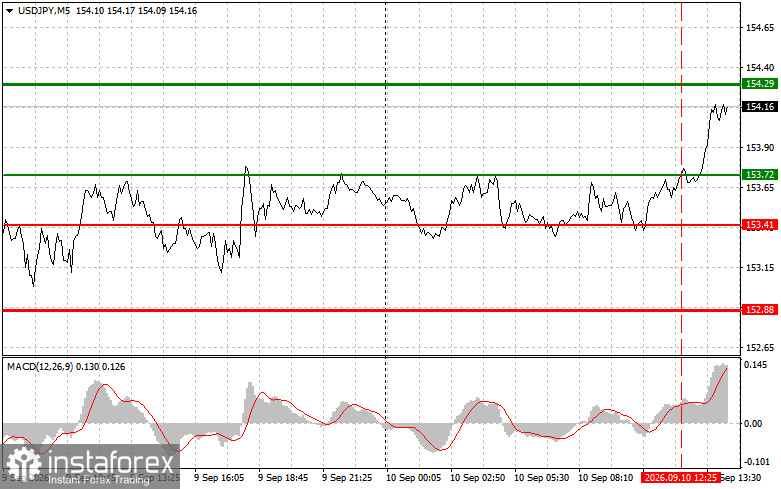
Buy Signal
Scenario No. 1: Today, I plan to buy USD/JPY when the entry point around 154.28 is reached (the green line on the chart), with a target of 155.06 (the thicker green line on the chart). Around 155.06, I will close the long positions and open short positions in the opposite direction, targeting a 30–35-point move in the opposite direction from the level. The pair may rise today, but the upside potential is relatively limited. Important! Before buying, make sure that the MACD indicator is above the zero line and has only just begun to rise from it.
Scenario No. 2: I also plan to buy USD/JPY today if the price tests 153.92 twice consecutively while the MACD indicator is in the oversold area. This will limit the pair's downward potential and lead to a reversal to the upside. A rise toward the opposite levels of 154.28 and 155.06 can be expected.
Sell Signal
Scenario No. 1: Today, I plan to sell USD/JPY after the price breaks below 153.92 (the red line on the chart), which should lead to a rapid decline in the pair. The key target for sellers will be 153.10, where I will close the short positions and immediately open long positions in the opposite direction, targeting a 20–25-point move in the opposite direction from the level. Downward pressure on the pair will return if the central bank intervenes. Important! Before selling, make sure that the MACD indicator is below the zero line and has only just begun to decline from it.
Scenario No. 2: I also plan to sell USD/JPY today if the price tests 154.28 twice consecutively while the MACD indicator is in the overbought area. This will limit the pair's upward potential and lead to a reversal to the downside. A decline toward the opposite levels of 153.92 and 153.10 can be expected.
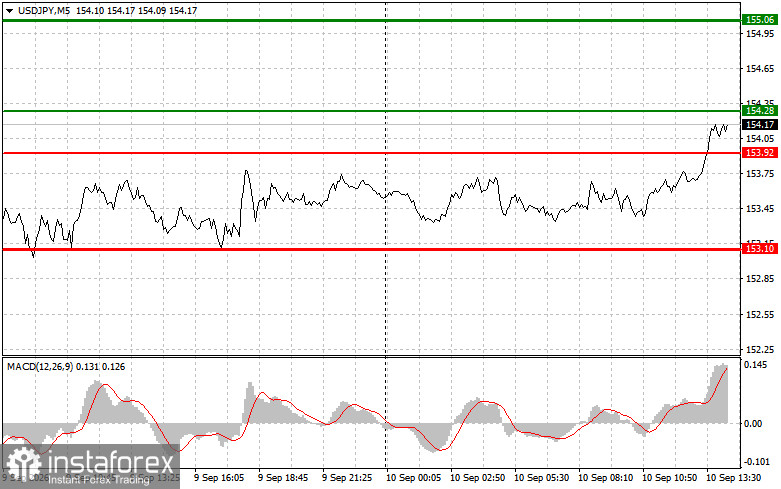
What the Chart Shows:
Important. Beginner Forex traders should be very cautious when making decisions about entering the market. Before the release of important fundamental reports, it is best to stay out of the market to avoid exposure to sharp exchange-rate fluctuations. If you decide to trade during news releases, always place stop orders to minimize losses. Without stop orders, you can lose your entire deposit very quickly, especially if you do not use proper money management and trade large volumes.
And remember that successful trading requires a clear trading plan, such as the one presented above. Making spontaneous trading decisions based on the current market situation is fundamentally an unsuccessful strategy for an intraday trader.


