
আরও দেখুন


 08.09.2026 10:39 AM
While Bitcoin — and the crypto market as a whole — has gradually been losing ground, Ethereum is preparing to solve one of the network's most annoying practical problems: the need to hold ETH in a wallet just to pay transaction fees.
The Hegota upgrade, scheduled for 2027, includes EIP-8141 — a proposal that builds the ability to pay gas in stablecoins directly into the protocol. Previously, a user had to keep two currencies in their wallet at once: the stablecoin or token they actually wanted to use, and ETH, without which the network would not process any transactions. That created friction even for people who never intended to use ETH directly and only wanted to transfer USDT or swap one token for another.
The facility to pay in non-ETH tokens is already available today, but it's implemented through third-party services that handle conversion and charge an extra fee. That's the main advantage of EIP-8141: the mechanism becomes part of the protocol itself, so users no longer need to find and trust external services — the network will handle charging fees in a convenient currency. To my mind, this simplicity is what makes the solution truly practical; it removes an onboarding barrier for new users who currently have to figure out where to get ETH before they can do anything on the network.
The proposal also introduces so-called Frame Transactions, which allow combining transaction approval and token swap into a single atomic operation. In plain terms, instead of two separate steps — first approving a contract to access tokens, then executing the swap — a user can do everything in one action, which is both faster and more reliable because it eliminates situations where the first step succeeds but the second hangs or fails. The same flexibility applies to wallet protection: the signing mechanism can be changed (including migration to quantum-resistant signature schemes) without having to move all funds to a new address, meaning users won't need to notify counterparties and services that their address has changed.
I expect that after EIP-8141 is implemented in 2027, the most noticeable practical effect will be the lower barrier for new users, since removing the need to hold two different currencies in one wallet affects virtually everyone who has ever used the Ethereum network.
Trading recommendations
Bitcoin
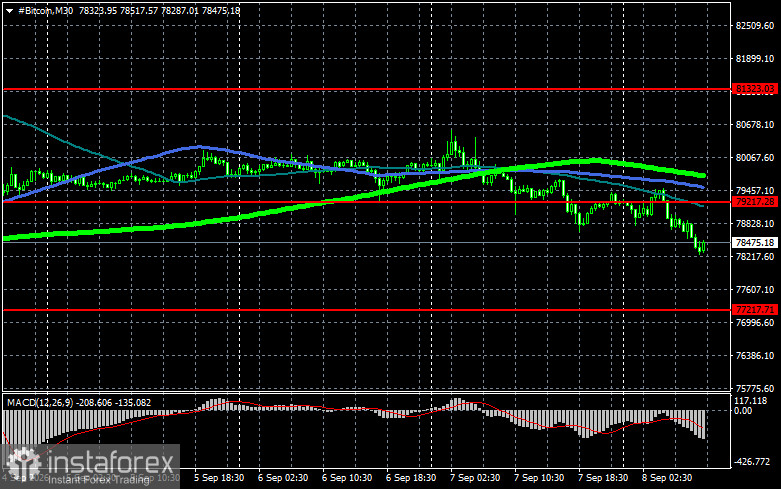
Buyers are now targeting a return to $79,217, which would open a direct path to $81,300 and then to $83,600; breaking above $83,600 would signal attempts to resume a bull market. On the downside, I expect buyers at $77,200. A return below that area could quickly push BTC toward $75,300. The furthest downside target is around $72,800.
Ethereum
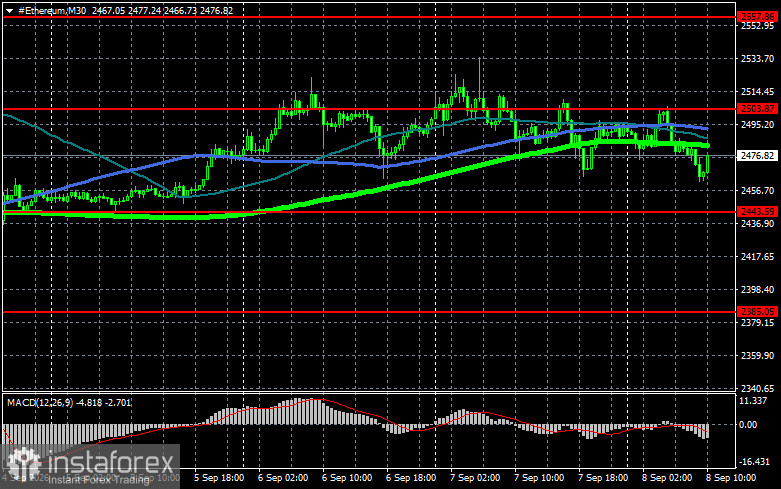
A clear hold above $2,503 opens a direct path to $2,557. The furthest upside target is the high near $2,624; breaking above that would indicate strengthening bullish sentiment and renewed buyer interest. On the downside, I expect buyers at $2,443. A drop back below that area could quickly push ETH toward $2,385. The furthest downside target is around $2,320.
What's on the chart
Price testing or crossing any of these moving averages often either halts movement or injects fresh momentum into the market.


